The Scaramanga Files

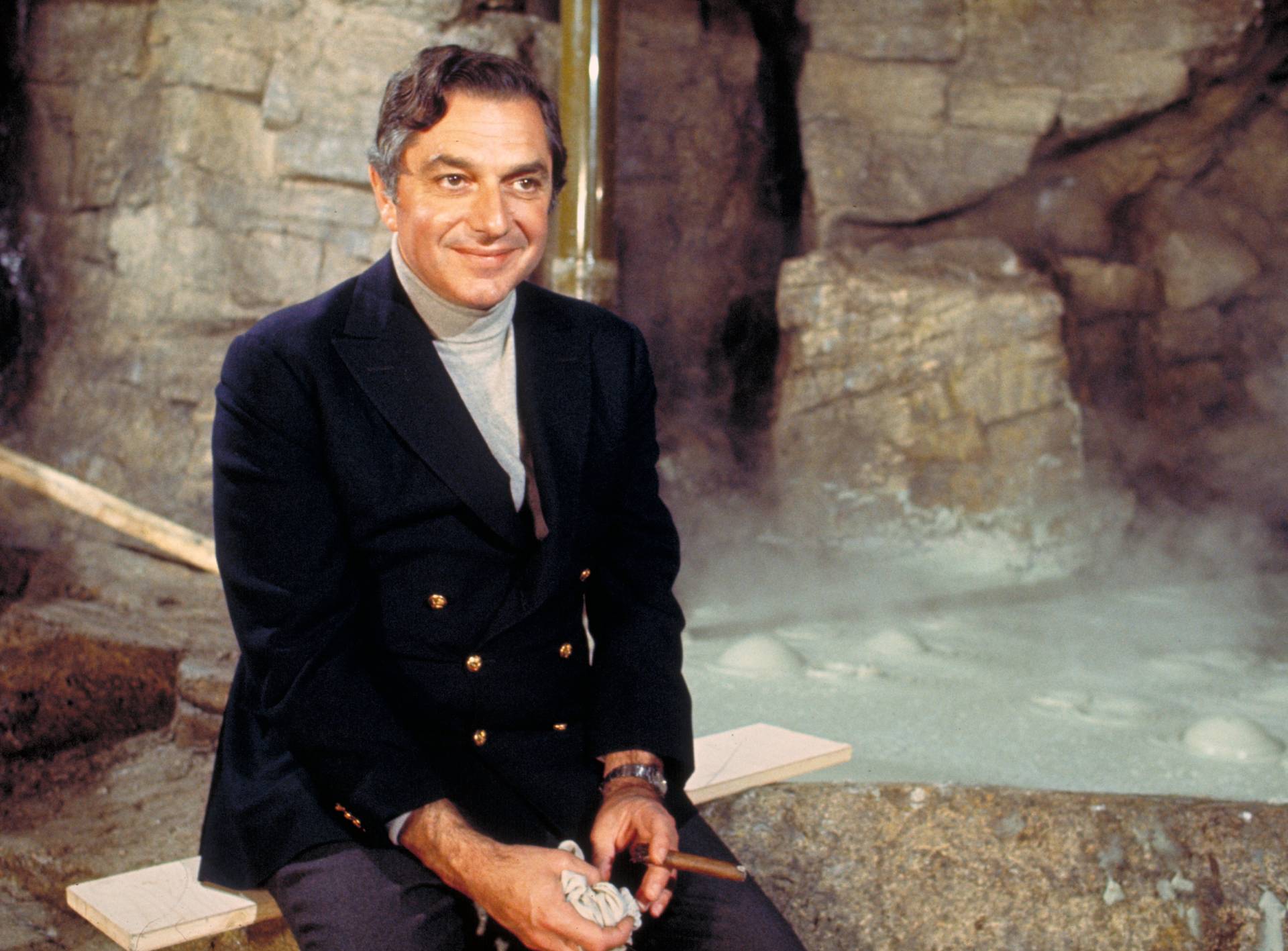
“He has a powerful weapon. He charges a million a shot. An assassin that is second to none,” Lulu’s theme for 1974’s The Man With The Golden Gun — music by John Barry, lyrics by Don Black — provided the perfect introduction to Francisco Scaramanga. Played with elegant menace by Christopher Lee, Scaramanga is a world-class hit man who is defined by his deadly custom-made pistol and his facility as a marksman, which is at least the equal of 007. Here’s the lowdown on one of Bond’s greatest adversaries.

Background: Scaramanga was born into a travelling circus, his Cuban father the ringmaster, his English mother a snake charmer. By the age of 10, the boy was a spectacular trick artist and, as a teenager, became a gunman in the Rio underworld. He was recruited by the KGB and was trained in his deadly trade in Europe. Yet, becoming an “overworked, underpaid” assassin, Scaramanga quit the KGB and became an independent operative in the late ‘50s. As Bond puts it, his current price is “$1 million a hit.”

The High Life: Scaramanga lives the life of a world-class assassin, building an extravagant home on his private island off the coast of southeastern China (part of a deal struck with the Chinese government to carry out assassinations in return). His island includes a solar power plant and a funhouse, which he uses to taunt and tease his various adversaries.
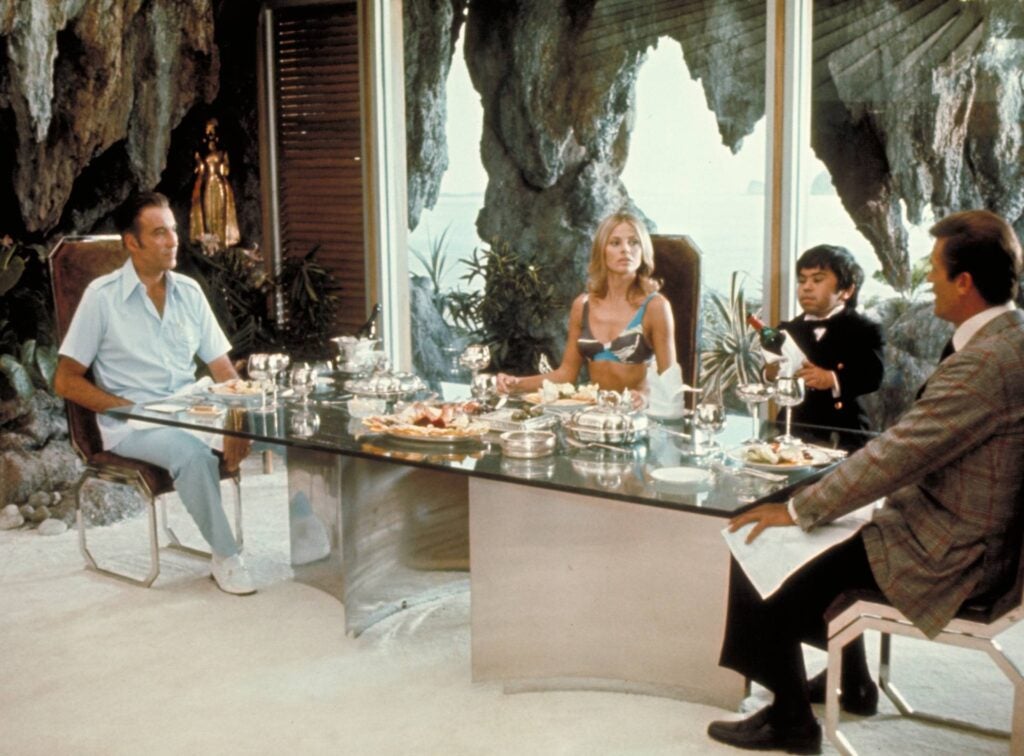
Accomplice: Nick Nack (Hervé Villechaize) is Scaramanga’s mischievous manservant. Nick Nack has multiple roles in Scaramanga’s employ. He is a butler, chief, assailant, and the arranger of various hitmen to come to Scaramanga’s island and kill him, as a way of keeping his boss sharp. Nick Nack also plays a pivotal role in stealing the Solex Agitator (a device that harnesses the sun’s power), a vital component in Scaramanga’s plot to auction off the world’s first solar energy system. As Bond arrives on Scaramanga’s island for a duel to the death, Nick Nack greets 007 with a bottle of champagne — in a moment of bravura, the assassin shoots off the cork — and then officiates over the deadly game.

Love Interest: Andrea Anders (Maud Adams) is Scaramanga’s mistress, but, in reality, is playing a deceitful double cross, sending Bond the golden bullet engraved with 007 to lure him into coming to kill Scaramanga to free her from a life she loathes — 007 takes the bait. Anders helps Bond, firstly by helping him get close to Scaramanga — directing him to the Bottoms Up club — and then by stealing the Solex Agitator. Scaramanga discovers her deception and kills her for betraying him.

Distinguishing features:  A third nipple. 

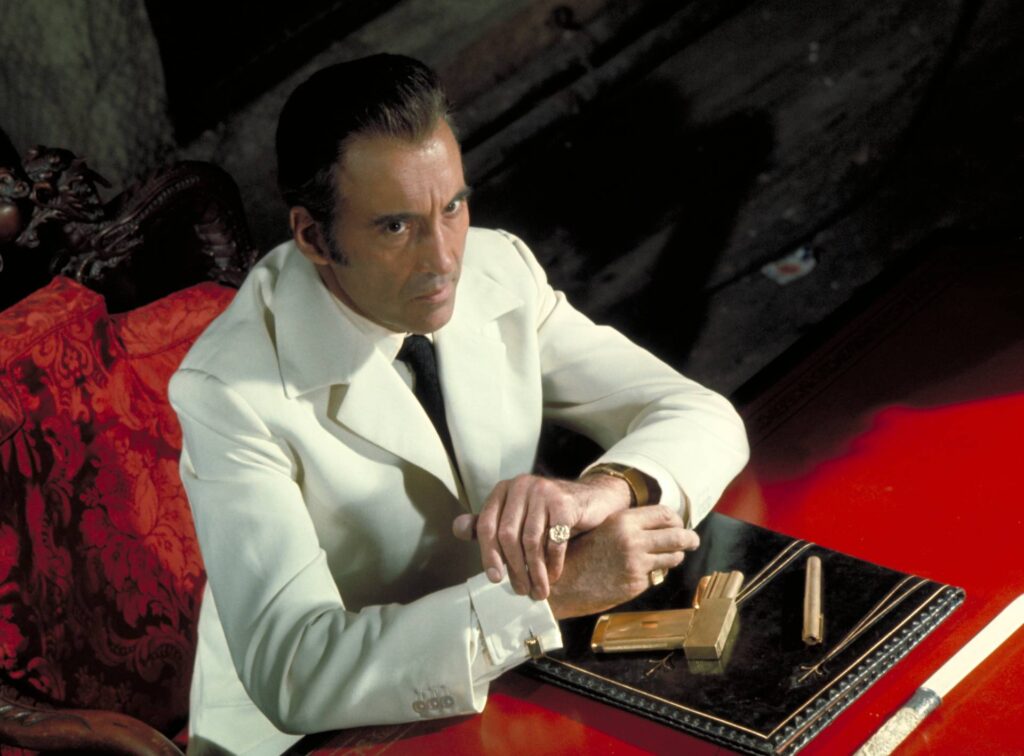
Weapons: Scaramanga’s weapon of choice is a gold-plated pistol that comprises four seemingly innocent objects: a pen, a lighter, a cigarette case and a cufflink. The single-shot firearm uses a custom-made 4.2-millimetre (.165 calibre) 23K golden dum-dum bullet with traces of nickel. Scaramanga has used the gun to kill gangster Rodney (Marc Lawrence), a British scientist Gibson (Gordon Everett), his own employer Hai Fat (Richard Loo) and even Bill Fairbanks, a 00 agent who was fatally wounded by a bullet in the neck.

Scaramanga’s home also plays host to a solar-powered laser cannon that the killer demonstrates to Bond by destroying the plane 007 arrived in. 
Vehicles: Scaramanga drives a 1974 AMC Matador X Coupé that comes into its own when intelligence officer Mary Goodnight (Britt Ekland) is bundled into the boot by Nick Nack and taken hostage. Bond, driving a commandeered AMC Hornet, gives chase through the busy Bangkok traffic. The chase concludes when the Matador pulls into an aircraft hangar and emerges as fit for flying via a wing attachment and jet engine. With an instrument panel replacing the car dashboard, the Matador soars into the skies — Goodnight gets a shock when she opens the boot to discover she is mid-air. 

Scaramanga also owns a Junk, the ramshackle exterior masking a high-tech interior. Bond steals it to make his escape as Scaramanga’s island is exploding. 

Dress sense: His signature look is a white suit, and he wears a ring with a huge stone on the little fingers of each of his hands. Scaramanga has also been known to wear a black suit, a royal blue tracksuit, and a short-sleeved, light blue shirt, blue flared trousers and white loafers.

Personality: Scaramanga is eccentric, arrogant, ruthless and sadistic. A self-professed gentleman who, like Bond, enjoys the finer things, including his own cordon bleu chef and an expensive wine cellar. He also seems to enjoy oysters served with Guinness and tabasco sauce. The assassin also boasts a sardonic sense of humour, such as following his murder of Hai Fat: “He always did like that mausoleum. Put him in it.”
Killer lines: (On inviting Bond to dinner) “Ours is the loneliest profession, Mr. Bond …So let us spend a few pleasant hours together”. (On killing Andrea Anders) “A mistress cannot serve two masters” (On the profession of murder) “Now, come, come, Mr. Bond. You disappoint me. You get as much fulfilment out of killing as I do, so why don’t you admit it?” (On revealing his lifetime’s ambition) “You see, Mr Bond, like every great artist, I want to create an indisputable masterpiece, once in my lifetime: the death of 007.”

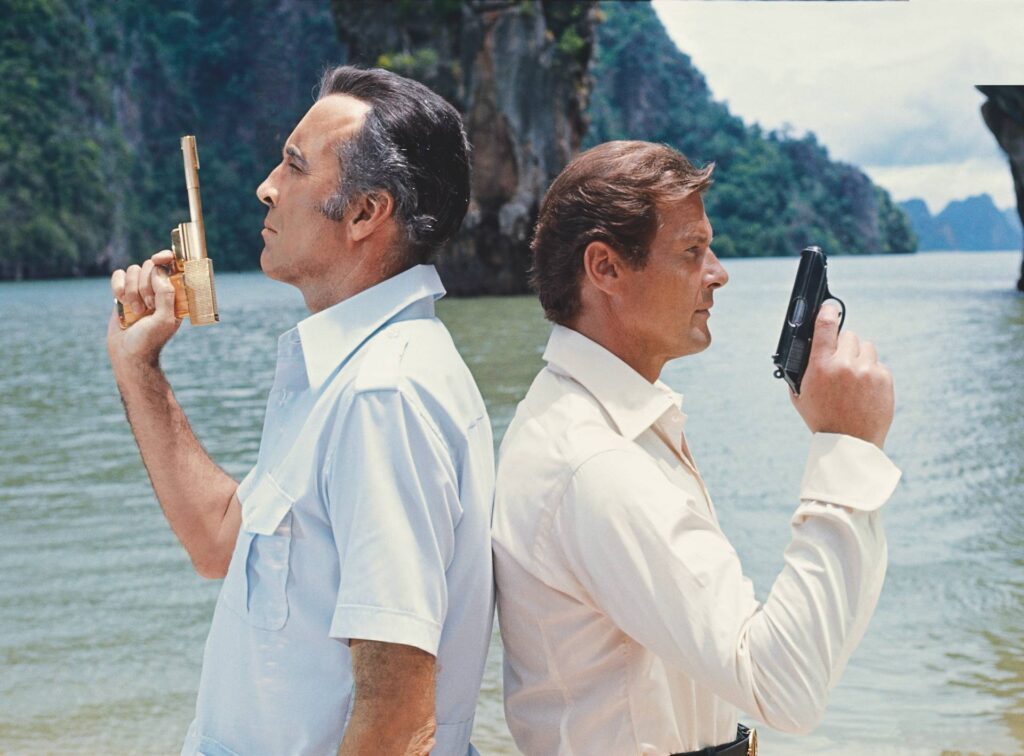
The Final Showdown: Bond takes on Scaramanga on the latter’s private island. It’s a battle between Scaramanga’s Golden Gun and Bond’s Walther PPK, with the former so confident he brags about needing just one bullet compared to Bond’s six. Beginning back-to-back like a classic pistols-at-dawn duel (“it remains the only true test for gentlemen,” says Scaramanga), the two men walk 20 paces, Scaramanga cheating by stealing into the labyrinthine maze of the funhouse. The two men stalk each other until Bond, posing as his own mannequin, kills Scaramanga with a single shot, the famous golden gun dropping from his side.
Location, Location, Location

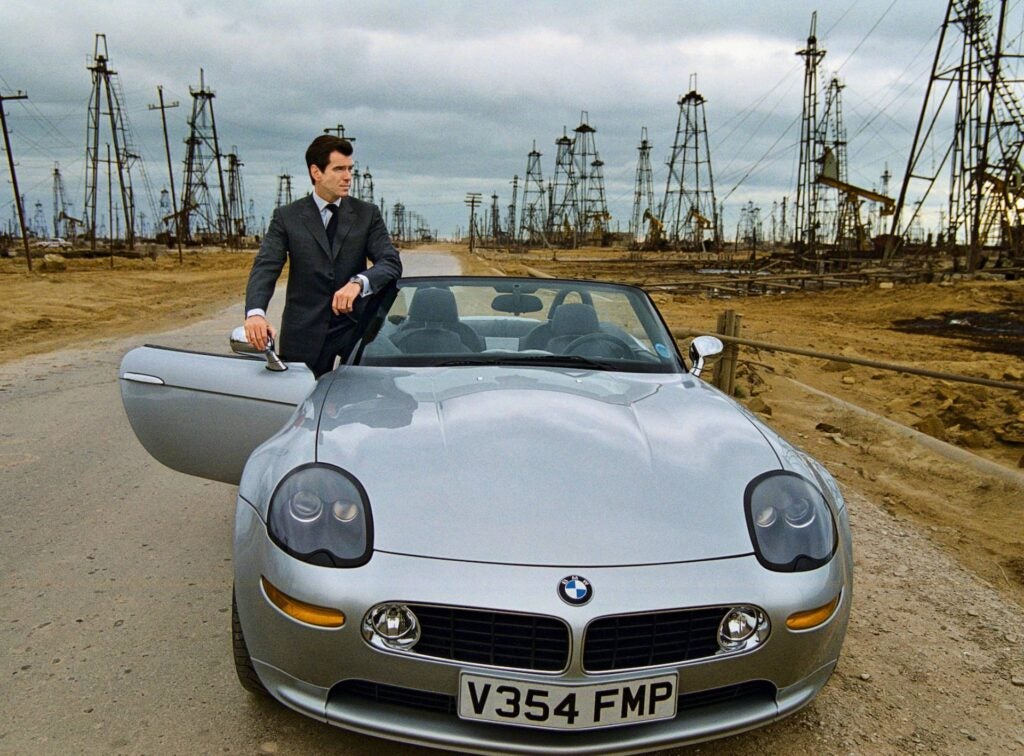
In his four-film tenure, Pierce Brosnan’s Bond visited iconic global locations, covering all terrains and temperatures. From sun-kissed beaches to freezing cold snowscapes, the beating heart of an urban metropolis to rugged mountain ranges, Brosnan’s 007 films have used impeccably researched locations to add touches of drama, glamour, romance and danger. Here are some of the best spots the fifth James Bond visited.

GoldenEye (1995)

Switzerland 

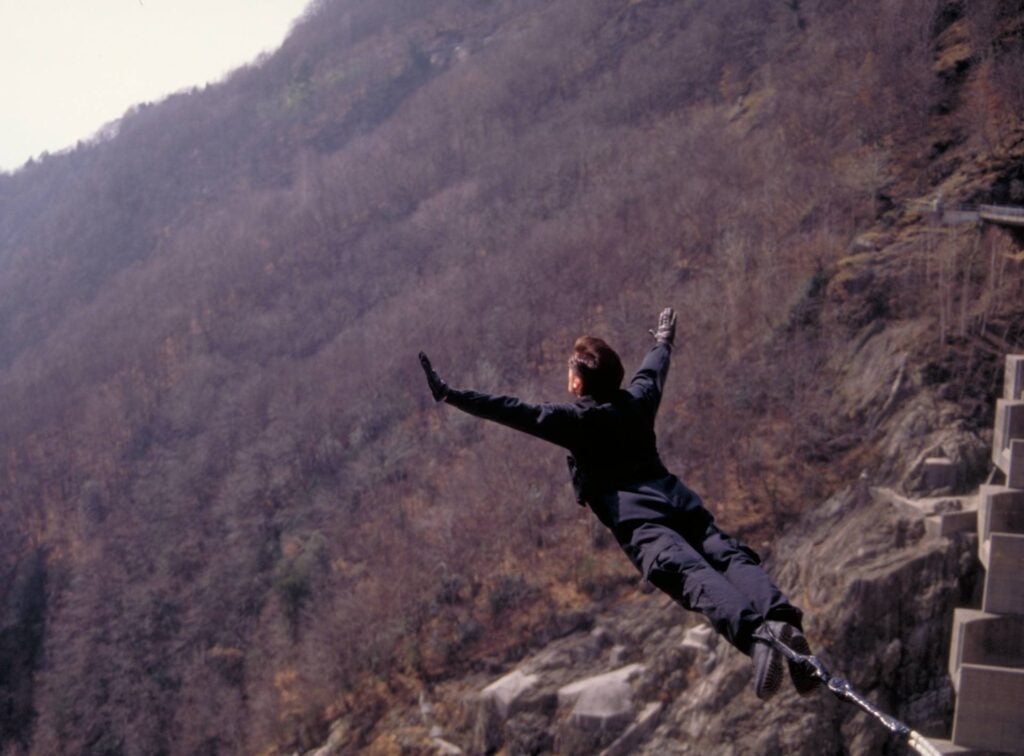
The mission: Bond and fellow MI6 agent Alec Trevelyan (Sean Bean) infiltrate a top-secret Soviet nerve gas facility in Arkhangelsk, Russia. Bond swallow-dives 640ft on a bungee, firing a piton gun into the facility’s roof and hauling himself down the remaining way. 

The Location: The scene was captured on March 11, 1995, at Verzasca Dam near Locarno, Switzerland, standing in for Russia. The record-breaking 640ft jump was performed by stuntman Wayne Michaels, who bruised his back and legs as winds pushed him into the concrete wall. 

Cuba

The mission: Bond and Natalya Simonova (Izabella Scorupco) travel to Cuba in search of the Goldeneye satellite dish. The pair discover the dish, which is submerged in a lake in the middle of a jungle to avoid detection from spy satellites and aerial reconnaissance. Bond begins to set remote charges, getting captured and brought before a gloating Alec Trevelyan (Sean Bean) to buy Natalya time to reprogram the satellites with new codes. 

The Location: The set-piece was shot at the Arecibo observatory (aka National Astronomy and Ionosphere Center) in Puerto Rico. The dish, which is over 1000 metres across, has produced maps of Venus and, in 1974, beamed the Arecibo message, an interstellar radio message conveying information about humanity and Earth into space. Unsurprisingly, the radar radio telescope could not submerge underwater, so Derek Meddings’ model unit created a miniature replica on the backlot of Leavesden studios. 


Tomorrow Never Dies (1997)

Russia

The Mission: A terrorist arms bazaar somewhere on the Russian border. Bond has infiltrated the sale to identify arms dealers and terrorists. Against M’s objections, the Royal Navy launch a missile strike, unaware that the terrorists have a military jet packed with two nuclear torpedoes. To avert environmental disaster, Bond steals the Russian plane and escapes, flying through the explosion after the missile impacts.

The Location: On January 20, the crew convened at Peyragude at Balcons de Peyresourde in the French Pyrenees to create the pre-credit sequence involving the arms sale. Chris Corbould’s crew blew up a missile launcher, a helicopter, a truck and a jeep. The cruise missile explosion consisted of 30 smaller explosions to make one big fireball. 

Saigon

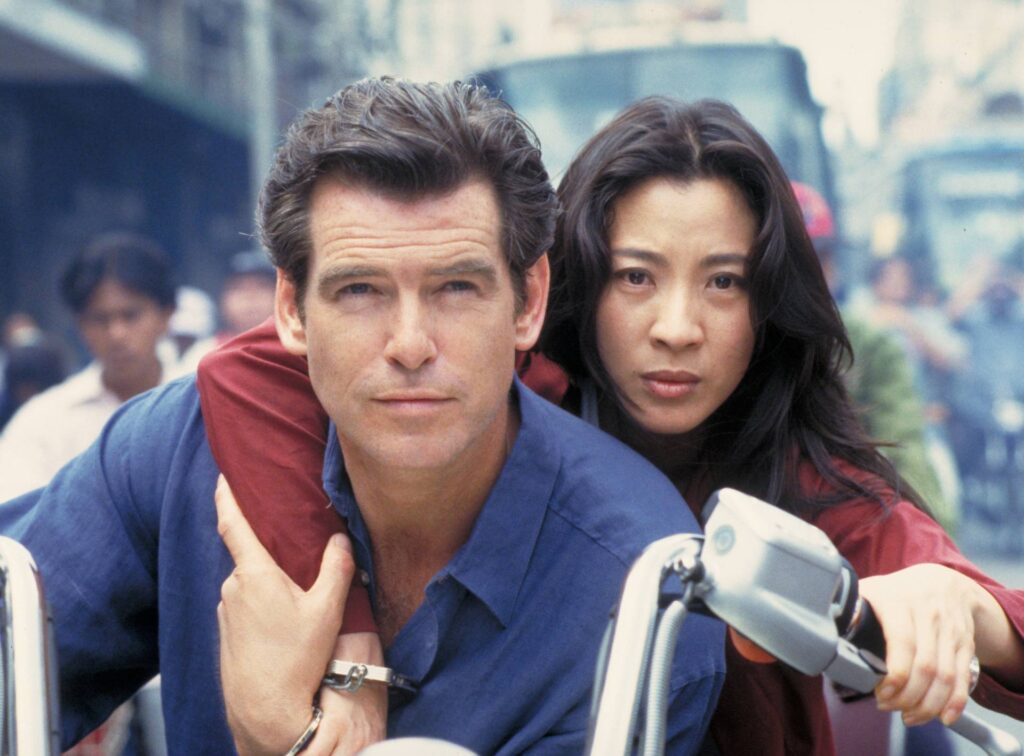
The Mission: Bond and Chinese agent Wai-Lin (Michelle Yeoh) are captured and taken to media mogul Elliott Carver’s HQ in Ho Chi Minh City. But, before Carver’s henchman Stamper can torture them, the pair escape by jumping through a window and sliding down a huge banner of Carver. A furious chase begins with Bond and Wai-Lin escaping on a motorbike — at one point, Bond performs a death-defying leap over a helicopter to evade his pursuers. 

The Location: Both the first and second units travelled to Thailand to create Bond and Wai-Lin’s bike chase through Saigon. Action unit director Vic Armstrong opted for a heavy-duty BMW R1 200 C Cruiser to perform the jumps and stunts to add further jeopardy. The unit captured Bond and Wai-Lin’s death-defying leap forty-three stories up the Sinn Sathorn Tower, the jump performed by Mark Southworth and Wendy Leech. 


The World Is Not Enough (1999)

London

The Mission: Bond returns the ransom money for Elektra King to her father, Sir Robert King, at MI6 in London. The metallic strip in one of the notes sparks a huge explosion that blows a hole in the wall of MI6 HQ. Spotting an assassin on a boat taking aim at him, 007 jumps into an experimental Q Dept jet-powered boat and gives chase down the Thames, taking shortcuts down narrow streets and through a restaurant, destroying the boat near the Millennium Dome. Escaping in a hot air balloon, the killer escapes in a hot air balloon but decides on self-destruction rather than Bond’s offer of protection.

The Location: This 14-minute set-piece was the longest pre-credit sequence at the time. With the pull of the 007 franchise opening up doors to stage a full-on boat chase in front of the Houses of Parliament,  the action was staged over five weeks from March 29 to May 7 — on the first day, a burst of gunfire provoked a member of the public to call the police, not aware that the police were already present. 

Azerbaijan 

The Mission: Bond meets Elektra King in Baku, Azerbaijan, offering his services of protection. In the Caucasus Mountains, Elektra shows Bond her pipeline, but the pair come under attack from a crew of armed assassins piloting parahawks. Bond sees off the aggressor, sending the parahawks colliding into each other, causing an explosion that initiates an avalanche. 007 saves the day as Bond deploys a rapid-inflating sphere.   

The Location: The second unit shot the parahawks sequence in Chamonix, France. The Parahawks, skidoos suspended from parachutes, were part of the Russian Special  Services Atomic Energy Anti-Terrorist Unit. It was so cold that the cameras were tested in the fridges at Heathrow airport, and the weather disrupted the schedule via overcast skies, avalanche warnings, and diesel freezing in the trucks. 


Die Another Day (2002)

Cuba

The Mission: Bond heads to Cuba on the trail of General Zao (Rick Yune), who has been spotted as a patient at the Clinica Alvarez, a clinic that uses DNA-modifying technology that can modify a person’s physical appearance to create a brand new identity. Posing as a bird watcher on a beach, Bond meets Jinx, a tourist who banters with Bond, and the pair spends the night together. The next day, Bond gains access to Alvarez’s clinics and discovers Zao. The pair fight, but Zao escapes, and the clinic catches fire following sabotage by Jinx, who is revealed as a CIA agent.

The Location: With the script demanding sunny climes, the crew headed to Cadiz in Spain as a proxy for Cuba, expecting high temperatures. Instead, they were greeted with rain, wind and cloud cover. Pierce Brosnan hammed it up, sporting a pink hot water bottle, which he described.

Iceland

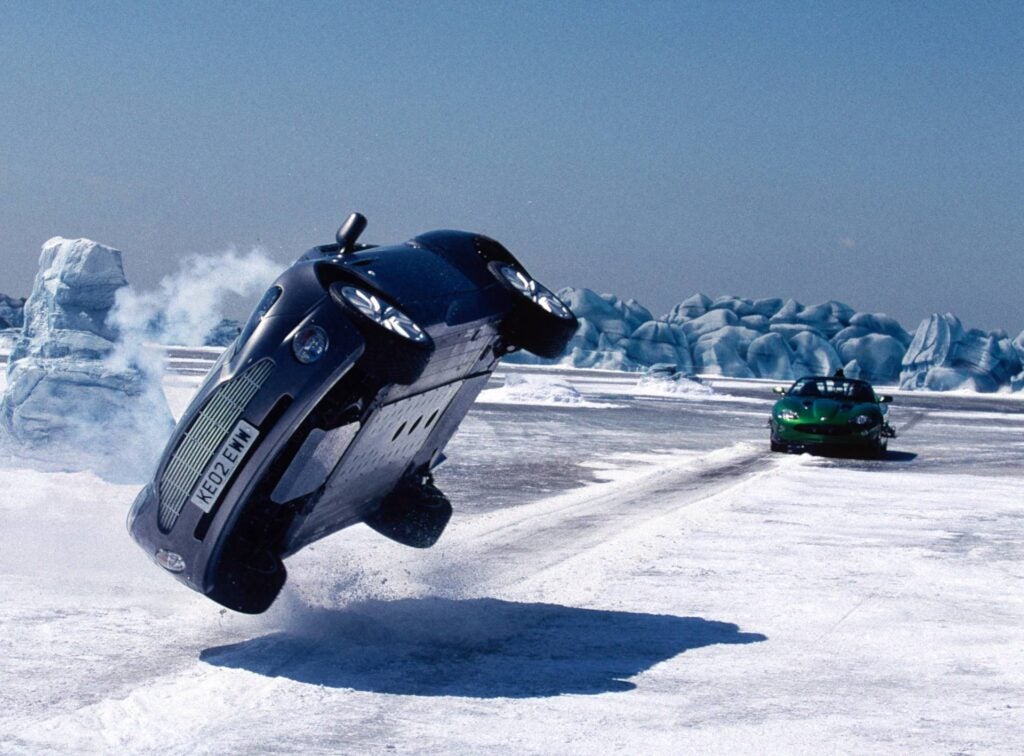
The Mission: On the invitation of Gustav Graves, Bond goes to Iceland to witness the unveiling of the Icarus project – a diamond-powered satellite with enough power to illuminate half the planet – at Graves’ spectacular ice palace. Reuniting with Jinx, the pair join forces — 007 saves her life from laser torture — as the real purpose of Graves’ satellite is revealed: a huge orbital space weapon transforms solar light into a huge destructive ray. Bond flees the powerful beam in Graves’ ice dragster. Bond returns in his Aston Martin in invisibility mode, taking on Zao in an epic car chase over icy wastes and into Graves’ fortress, the palace melting from the power of the heat ray.

The Location: To shoot the ballet between Bond’s V12 and Zao’s Jaguar XKR, the production found a spectacular lagoon near Vatnajökull, which not only freezes over but is also surrounded by icebergs. Unfortunately, Iceland went through unprecedented warm conditions, causing the lagoon to thaw. The unit looked at alternative locations in Alaska, but the cost was prohibitively high. Then the Iceland location experienced its coldest February for 60 years, and the ice froze to a depth that could host a hot pursuit. Still, the camera car was fitted with floatation devices in case the surface cracked.

Statement from Amazon MGM Studios

Statement from Amazon MGM Studios: “The search for the next James Bond is underway. While we don’t plan to comment on specific details during the casting process, we’re excited to share more news with 007 fans as soon as the time is right.”

James Bond Style Icons

James Bond has a strong claim to be the best-dressed character in movie history. From the well-tailored power suits to super tight rollnecks, from uber-fashionable linen suits to the best towel-wear imaginable (see Goldfinger), 007 has long set the standard for fashion in film. But surrounding the main man are female accomplices, villains and henchmen who allow the costume designers to really cut loose. Here are a cavalcade of characters whose look would be at home on any fashion catwalk or Met Gala staircase. Strike a pose. 

Dr. No

Dr. No (1962)

Costume Designer: Tessa Prendergast

The first on-screen 007 villain, Dr. No’s (Joseph Wiseman) look is perhaps the most influential fashion choice from the whole Bond series. Too busy being a criminal mastermind to worry about choosing a suit and tie, No’s Mandarin-collared Nehru jacket is deeply influenced by the military uniforms and has become an inspiration for many Bond baddies and beyond, from Blofeld to No Time To Die’s Lyutsifer Safin.

Pussy Galore

Goldfinger (1964)

Costume Designer: Elsa Fennell

The head pilot of Goldfinger’s personal air force, Pussy Galore dresses for business and practically, but always with oodles of panache. Be it on board Goldfinger’s jet, wearing a black suit trimmed with, aptly enough, gold, to a purple wrap blouse that belies her skill at judo, her sartorial splendour is always a match for Bond.

Auric Goldfinger

Goldfinger (1964)

Costume Designer: Elsa Fennell

The original hipster, Auric Goldfinger (Gert Fröbe), is a larger-than-life criminal with a dress sense to match. His wardrobe often mirrors his love of gold, clothes swathed in ambers, browns and honeys. But perhaps his most striking look comes when he takes on 007 (Sean Connery) on a golf course, sporting a striking woollen ensemble — a flat cap to put Peaky Blinders to shame, a preppy jacket, plus fours — so classy you could almost forgive him his cheating. Almost.

Tracy di Vincenzo

On Her Majesty’s Secret Service (1969)

Costume Designer: Marjory Cornelius

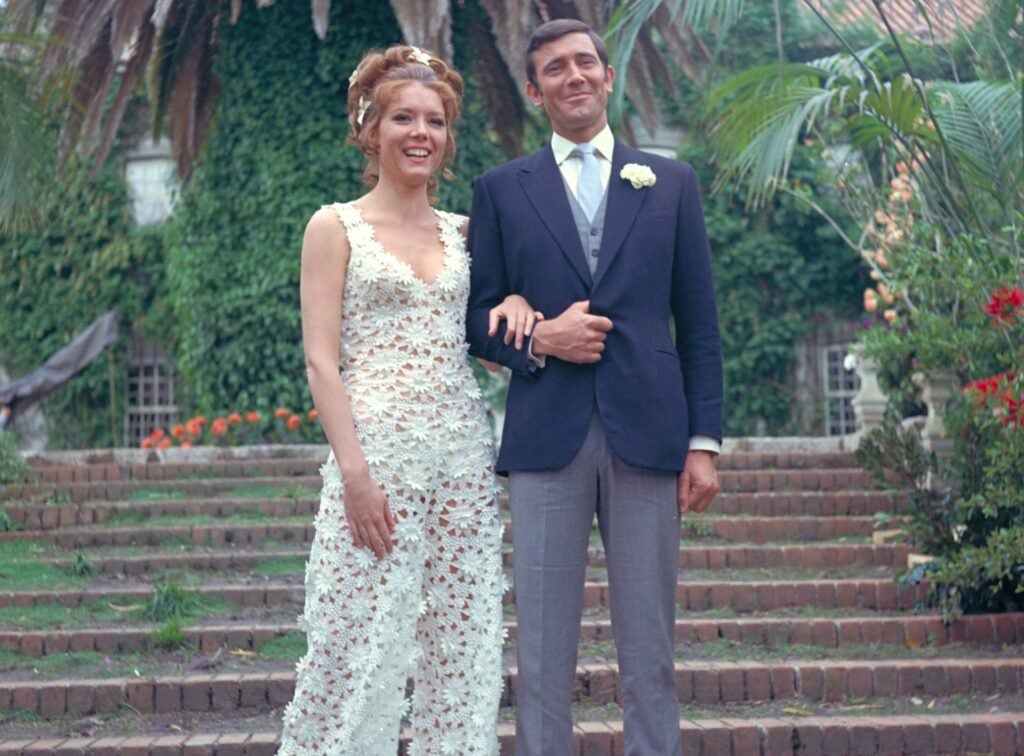
From the first moment we meet Tracy di Vicenzo (Diana Rigg), wading out to sea in a gown boasting huge diaphanous sleeves, she is an instant style exemplar. In a film full of bold female fashion choices — also see Blofeld’s Angels Of Death — Tracy is the standout, be it showing off a crisp white gown in a casino or sporting a fedora hat while horse-riding with Bond (George Lazenby). In the film’s poignant finale, she is seen wearing a beautiful daisy-appliqué jumpsuit for her wedding, only to be Mrs. Bond for a tragically short period. 

Solitaire

Live And Let Die (1973)

Costume Designer: Julie Harris

There are not many characters in the James Bond universe who get more colourful costume changes than Jane Seymour’s Solitaire. Her dreamy outfits redefine lavish, from an intricately detailed turquoise jumpsuit to an elaborate red and gold dress to a pink translucent night gown. Being an enigmatic tarot reader, she’s also not afraid to rock a headdress. It’s all incredibly ‘70s but completely unforgettable. 

May Day

A View To A Kill (1985)

Costume Designer: Emma Porteous, Azzedine Alaïa

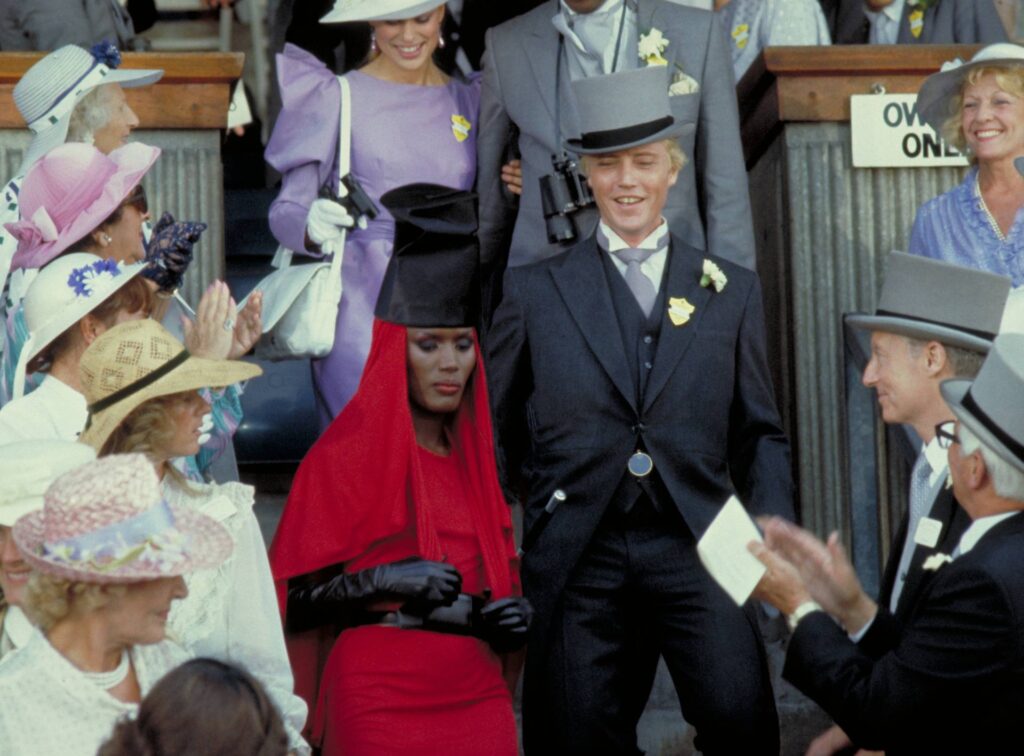
The bodyguard and lover of crazed industrialist Max Zorin (Christopher Walken), May Day (Grace Jones), oozes flamboyance, especially in her outrageous fashion sense. Created by Jones’ fashion designer friend Azzedine Alaïa. May Day’s signature look includes hooded capes, clingy dresses and touches of leather that were good for any occasion, be it a day at the races or diving off the Eiffel Tower. Iconic. 

Pam Bouvier

Licence To Kill (1989)

Costume Designer: Jodie Tillen

Played by Carey Lowell, a former top model who walked Ralph Lauren and Calvin Klein’s runways, Pam Bouvier has a dress sense that might not be the most outlandish but it does include one piece that warrants celebration: a dress that allows the hem to be ripped away, enabling Bouvier to quickly access the gun in her garter or run faster in a chase (the idea came from director John Glen). Utilising 160 fasteners and good old Velcro, the garment is also a thing of beauty, graced with beadwork that took a month of workmanship. Like Pam, it’s organised, efficient, sophisticated.

Xenia Onatopp

GoldenEye (1995)

Costume Designer: Lindy Hemming

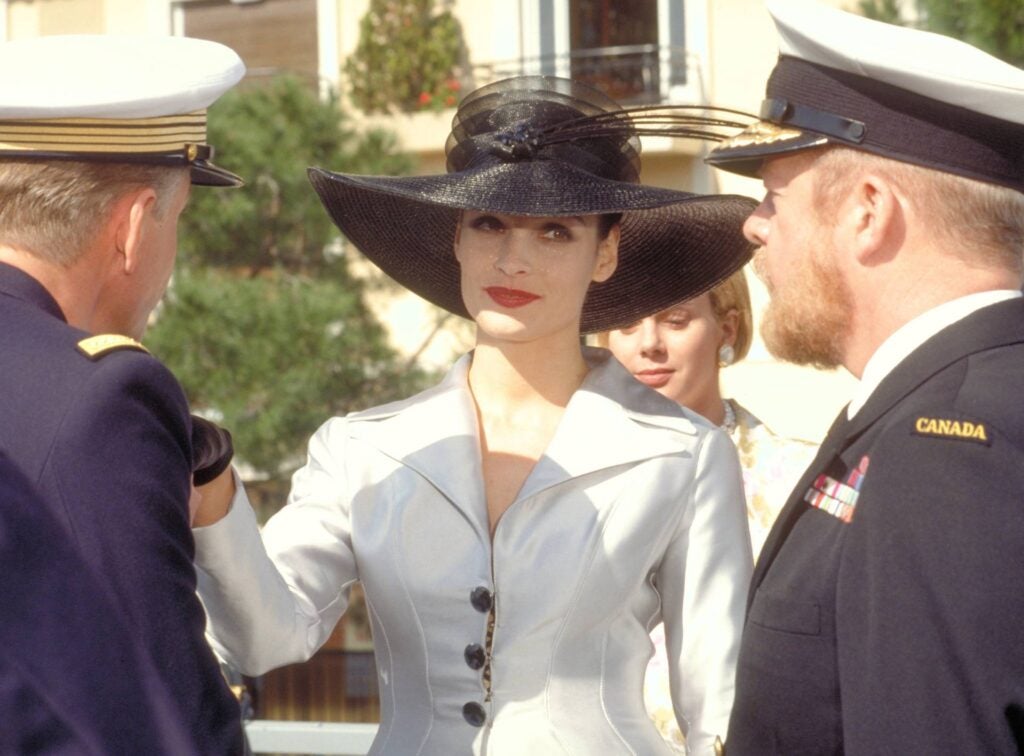
“Cruella De Vil meets Morticia Addams” is costume designer Lindy Hemming’s snappy description of Xenia Onatopp (Famke Janssen)’s look. The Russian assassin’s look is dominated by razor-sharp suits, slinky gothic mini-dresses (black gloves a must), sometimes adorned with icy mirrored accoutrements. On board a military ship in Monaco, she kills two helicopter pilots; her dramatic, wide-brimmed hat covers a multitude of sins (the headwear was designed by Philip Somerville, who also created the striking fur hat worn by Elektra King in The World Is Not Enough’s ski sequences).

Vesper Lynd

Casino Royale (2006)

Costume Designer: Lindy Hemming

“I’m the money”, announces Vesper Lynd (Eva Green), wearing an Alexander McQueen overcoat, to James Bond (Daniel Craig) as she sits opposite him on a train bound for Montenegro. It’s an introduction that could easily describe her expensive, chic wardrobe. The star of the show is perhaps the deep purple Roberto Cavalli gown, complete with a plunging neckline and low open back, that Vesper wears at Casino Royale, designed to distract the other players in the high-stakes poker game. 

Silva 

Skyfall (2012)

Costume Designer: Jany Temime

When it comes to being well-dressed, Silva (Javier Bardem) gives 007 (Daniel Craig) a run for his money. On his introduction in the computer room of the dead city on his unnamed island, he sports a cream, single-breasted silk jacket, a Prada silk shirt, an olive waistcoat and Jeffery-West Marriott Brogue Cricket Chelsea Boots. It’s a well-tailored Mediterranean look that still perfectly conveys the character’s sensitive but unstable sensibility. 

Paloma In Profile

A pivotal figure in 2021’s No Time To Die, Paloma is Bond’s guide through the colourful nighttime streets of Santiago de Cuba. Played by Ana de Armas, she is a naïve, gauche newbie who turns out to be a resourceful and deadly asset in Bond’s mission. Below is a deep dive, both on-screen and off, into one of 007’s most vibrant allies. Vamos!

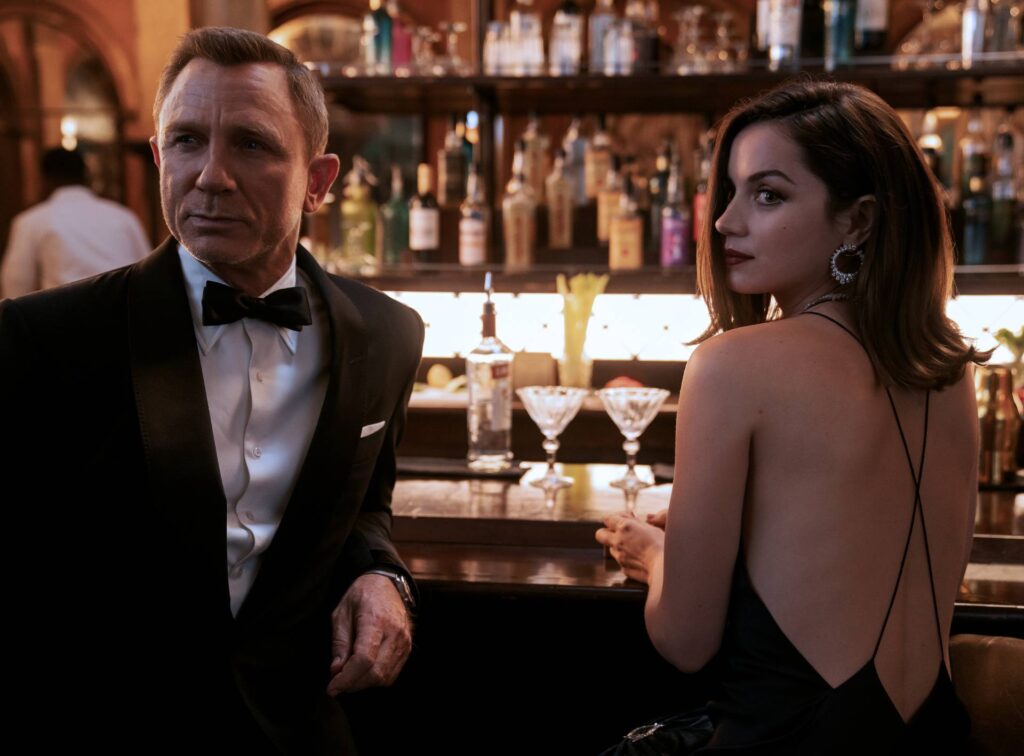
THE CHARACTER: Paloma first encounters Bond, working under the auspices of the CIA, at the brightly lit El Nido Bar in Cuba. Bond reminds her of the code words — “Something about a hat? Paris?” — but the inexperienced agent is too preoccupied to care. “I forget things when I get nervous,” she says. “This is the biggest job I’ve ever had.” 

Paloma leads 007 to a downstairs wine cellar and gives him his (Tom Ford) tuxedo. Working from Felix Leiter’s orders, the pair’s mission is to enter a swish SPECTRE party at the Hotel Olympiad to extract the scientist Valdo Obruchev (David Dencik), who had been kidnapped by the organisation from a MI6 Laboratory. 

After Paloma reveals she has only done three weeks of training, further raising Bond’s doubts, the pair stroll into the party and Bond suggests a drink (two vodka martinis, shaken not stirred, naturally). From her lipstick tube, Paloma produces an earpiece (“So I can hear you”) and the pair toast Felix — Paloma downs her drink in one.

Bond and Paloma split up, communicating through the earpieces (“Have you ever been to a party like this?” asks 007. “How do you think I got this job?” replies Paloma). Paloma taps into SPECTRE’s technology, and Bond recognises the voice of Blofeld (Christoph Waltz), whom 007 had imprisoned in Belmarsh prison. Paloma spots Obruchev and starts tailing him. 

The gathering is revealed as a ruse by Blofeld to trap and kill Bond by using nanobot technology, the former surveying the party from Belmarsh utilising his bionic ocular implant. Placing 007 in a harsh spotlight, Blofeld unleashes a mist containing deadly nanobots designed to kill him. But in a further twist, the nanobots have been reprogrammed by Obruchev to ignore Bond and kill only SPECTRE operatives. 

In the melee that follows, Paloma spots Obruchev and, along with Bond, starts to hurry him out of the building, revealing herself to be a crack shot with a gun. Still, their bounty is stolen by rival MI6 agent Nomi (Lashana Lynch), who bungees through the glass ceiling (“May I cut in?”) and bounces out with Obruchev in her arms. 

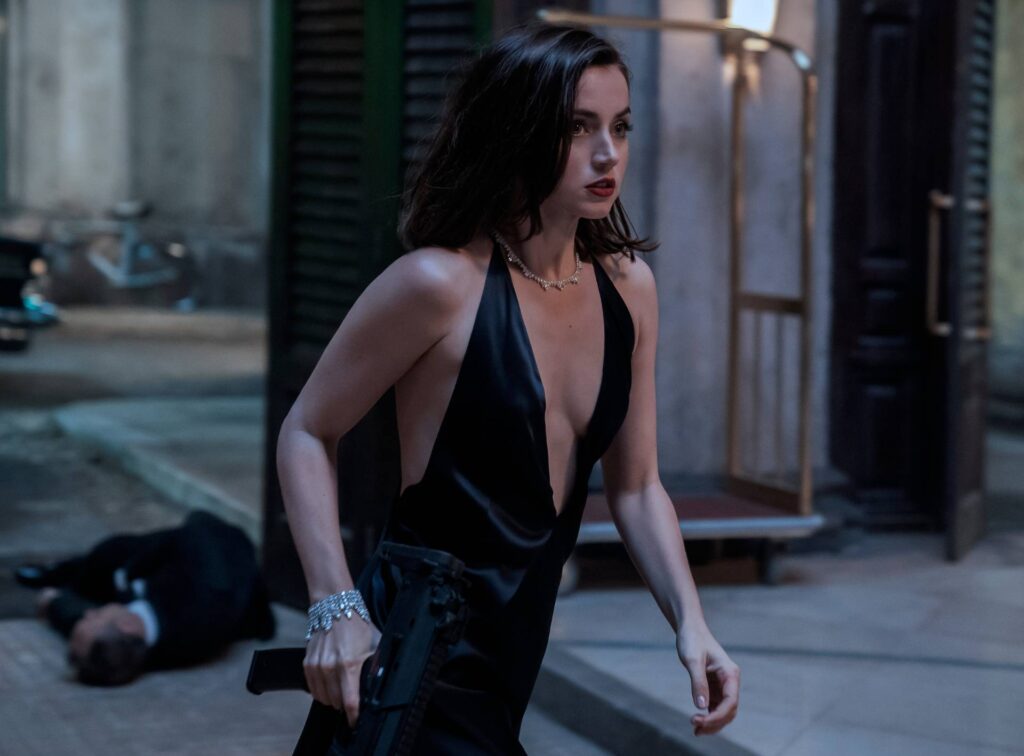
Bond gives chase while Paloma holds off the attackers with some deadly two-handed gunplay. Soon she runs out of ammunition but keeps Bond safe with a dazzling display of martial arts, kicking over, then shooting her attackers. In the eye of the storm, Bond and Paloma share a quick drink as 007 marvels at her prowess (“Three weeks training? Really?” he asks. “More or less” comes the reply) 

As a refreshed Bond goes in search of Nomi and Obruchev, Paloma steals a classic car. Noticing Obruchev has stepped onto scaffolding to make his escape, she drives the vehicle headlong into the structure, bringing it and the scientist down on her bonnet. Bond arrives and takes Obruchev to Nomi’s plane and an escape route.

THE CREATION: “As a young actress, I looked at Bond Girls like a myth and never thought I could be one, because it was hard to relate to perfection,” de Armas told Mark Salisbury for the Being Bond book. “I was really flattered that Cary, Daniel, and the producers thought of me.”

De Armas, who had previously worked with Craig on Knives Out, was delighted that her induction into the world of 007 meant she could play a three-dimensional character rather than an untouchable icon. 

“When I read the script, I was surprised, too, because Paloma has flaws, she’s not perfect, she’s messy and scared and tipsy and makes mistakes,” de Armas said. “On the other hand, she’s nothing close to the damsel in distress. She’s actually the opposite. She’s there to help James Bond get through the night alive. It’s her territory, and so, at least for the night, she’s in charge. That felt very powerful and very exciting.”

Even if Paloma was a new kind of Bond ally, she still had to invoke the glamour that is the series’ trademark. So, de Armas sported a navy blue, almost backless dress created by costume designer Suttirat Anne Larlarb that served both the story and the character’s high style.

“Paloma is basically earning her stripes,” said Larlarb. “We had discussions about women in these positions, who have to embed themselves in the situation when they’re being called to serve. In the case of Paloma, our introduction to her is at the extravagant SPECTRE party that’s happening in Cuba, which is a black-tie event. So, not to be singled out, she’s basically in this spectacular dress, and does incredible feats in this wisp of a thing. Especially on a franchise like this, it’s important when you turn up the volume, you turn it up really high.”

To portray Paloma as Bond’s partner in punch-ups, de Armas went through two weeks of intensive training, learning to handle weapons and thrive in hand-to-hand combat. The actor called the training “probably the hardest thing I’ve ever done” and, for stunt co-ordinator Olivier Schneider, the character’s fashion sense amped up the difficulty factor to the max.

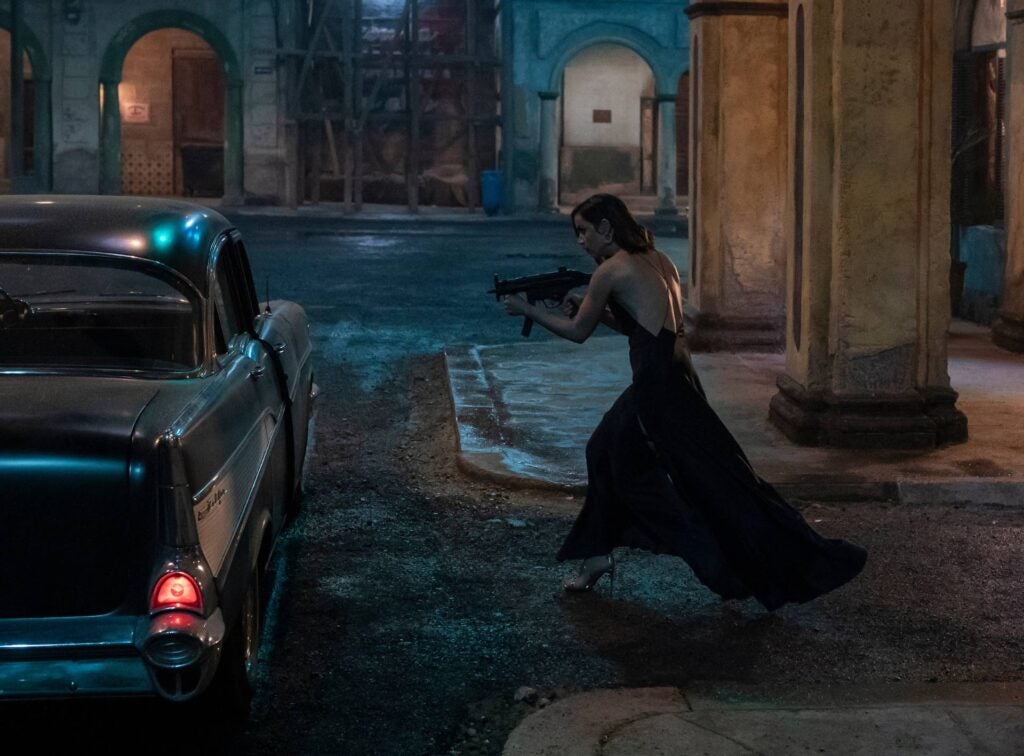
“I understood she wanted that [a beautiful dress] because it’s her character Paloma and looks fantastic on the screen,” says Schneider. “But for Patrick [Vo], the fight coordinator and myself, it was a nightmare because she could break her ankle at any moment in high heels. And, because of the dress, I couldn’t put any pads on her because she had bare legs. We had to design a fight around all of that. Ana rehearsed very hard to make that happen. It was a pure pleasure doing it.”

When it came time to shoot the sequence, the Cuban born de Armas was wowed by the Cuban street scene recreated on the Pinewood backlot.

“It was really stunning,” she recalled. “I was shocked at the size and scale of the whole thing. It was pretty accurate: the colours, the textures, just the feeling of it.”

Still, she had one reservation, perhaps heightened by her spectacular, if flimsy, costume.

“The only thing that didn’t match was the weather,” she laughed, “but I guess you can’t tell that on camera.” 

The Animals Of James Bond

Over its 25-film history, the James Bond films have often used animals as a storytelling tool, be it as a threat to 007 (Blofeld’s piranhas in You Only Live Twice), establishing character (Kincaid’s gundogs in Skyfall), adding exotic spectacle (the elephants and tiger seen on safari during Octopussy) or providing comic relief (the St. Bernard who brings Bond a tipple in On Her Majesty’s Secret Service). Here are ten great animal appearances from the 007 menagerie…

Dr. No’s Tarantula

As seen in: Dr. No (1962)

On-screen: Dr. No (Joseph Wiseman) instructs Professor Dent (Anthony Dawson) to kill Bond (Sean Connery) with a deadly tarantula. In a tense scene, Bond lies in bed and feels the presence of the arachnid, watching it crawl slowly over his body. When the spider moves off the bed, Bond dramatically bludgeons it with his shoe.

Off-screen: After a plastic spider didn’t work, the team tried a real tarantula, but with a piece of perspex between the animal and the actor — the ruse was abandoned when the camera was constantly caught in the reflection. When director Terence Young decided the spider should be seen moving across 007’s body, Connery steadfastly refused, so stuntman Bob Simmons stepped in.

Blofeld’s Turkish Angora Cat

As seen in: From Russia With Love (1963)

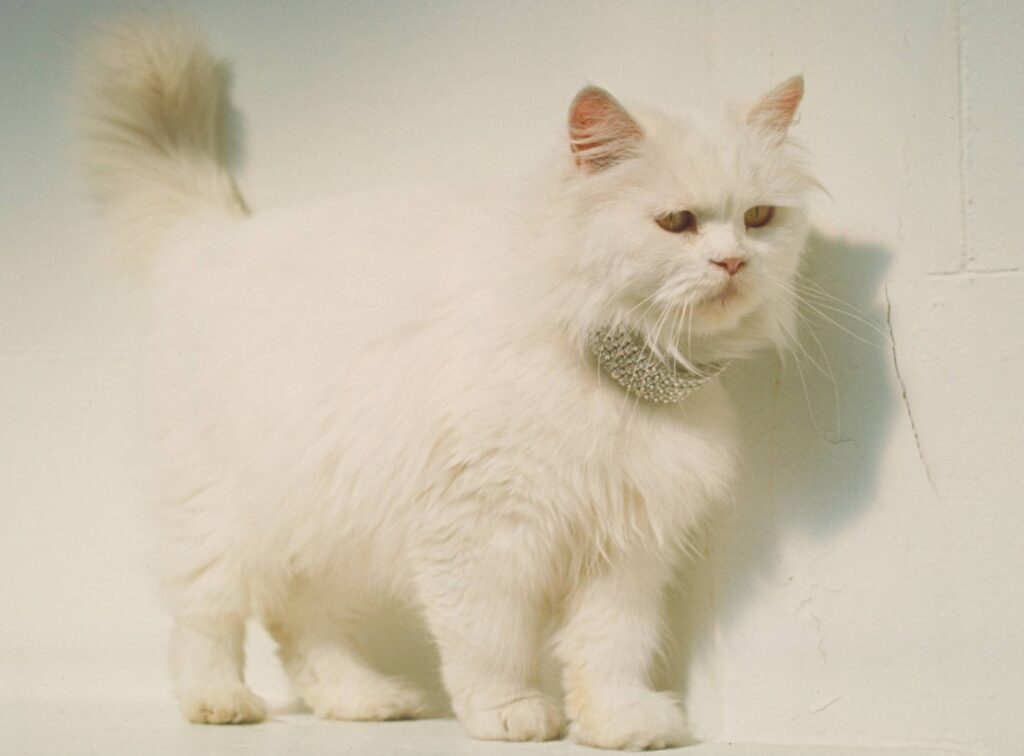
On-screen: Played by a returning Anthony Dawson (but we never see his face), Ernst Stavro Blofeld’s introduction to the series — in a meeting where he hires Rosa Klebb (Lotte Lenya) to steal the Lektor machine and kill 007 — is also our first glimpse of his now iconic cat, a white, blue-eyed Turkish Angora. The cat later appeared in Thunderball, You Only Live Twice, On Her Majesty’s Secret Service, Diamonds Are Forever (wearing a diamond collar), For Your Eyes Only, and Spectre, where the cat jumps on Bond’s lap when Franz Oberhauser (Christoph Waltz) reveals his identity as Blofeld.

Off-screen: The only film that features Blofeld but not his cat is No Time To Die.

Bond’s Seagull

As seen in: Goldfinger (1964)

On-screen: In the pre-credit sequence, Bond (Sean Connery) approaches a Mexican port from the water as part of a mission to blow up a drug manufacturing complex. He sports a seagull atop his dry suit as a creative means of disguise.

Off-screen: In previous drafts of the screenplay, Bond avoided detection by wearing a dead dog in his head!

Largo’s Sharks

As seen in: Thunderball (1965)

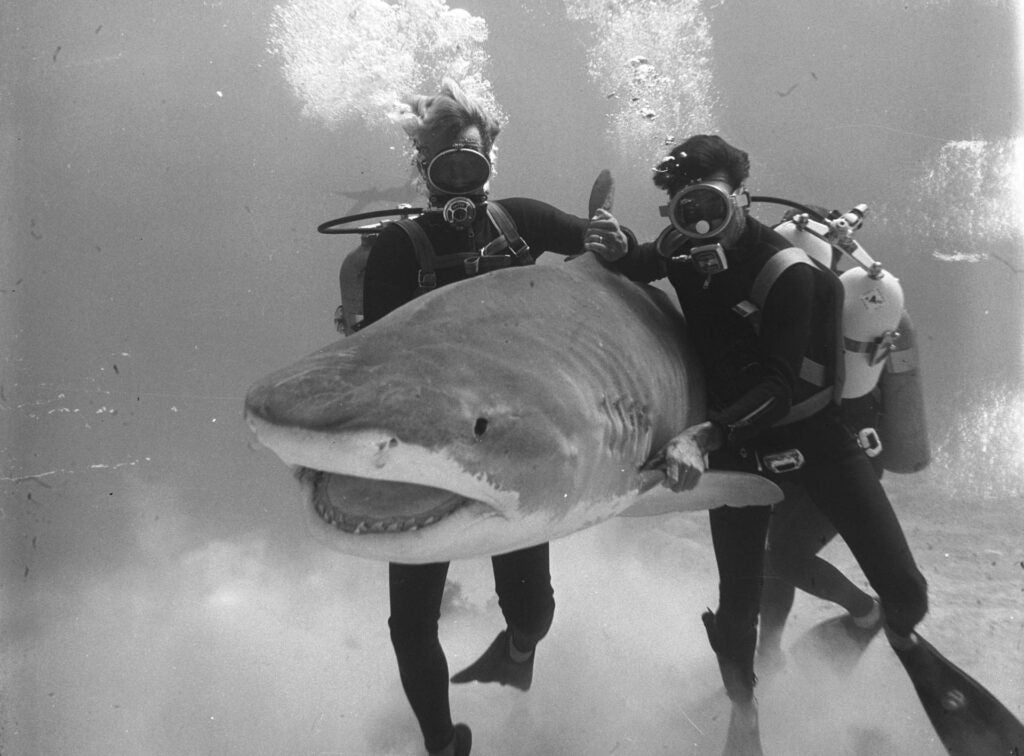
On-screen: Bond (Sean Connery) infiltrates Emilio Largo’s (Adolfo Celi) compound at night, but, trying to make his escape, becomes trapped fighting an assailant under a metallic cover in a swimming pool. 007 kills his attacker but faces a new threat when sharks are let loose from a separate pool. Using his Q Dept. rebreather, Bond stays beneath the surface and opens the hatch allowing the sharks to glide past. He then swims through the tunnel and slips out of the empty pool.

Off-screen: For the shot of Connery watching the sharks swim by, the actor refused to get in the water with the animals, so production designer Ken Adam (once again) employed a plexiglass tunnel so the actor could be kept safe from the sharks. Connery insisted not only that director Terence Young tried the shot out first but also that he stayed inside the pool for the take. During one take, a shark breached the tunnel and ended up nose to nose with the star, meaning that, at one point in the sequence, Connery is clearly not acting.

Emilio Largo was not the only Bond villain to keep sharks. Dr. Kananga (Yaphet Kotto) in Live And Let Die, Karl Stromberg (Curt Jürgens) in The Spy Who Loved Me, and Franz Sanchez (Robert Davi) in Licence To Kill all deployed the apex predators for nefarious reasons.

Mr Wint’s Scorpion

As seen in: Diamonds Are Forever (1971)

On-screen: Ordered by Blofeld (Charles Gray) to kill every link in a chain of diamond smugglers, assassins Mr. Wint (Bruce Glover) and Mr. Kidd (Putter Smith) confront dentist turned diamond smuggler Dr. Tynan (Henry Rowland) in the South African desert. While Kidd feigns a toothache, duping Tynan into staring into his mouth, Wint slips a scorpion inside the dentist’s shirt, the sting killing in seconds. “One of nature’s finest killers, Mr. Wint” says Kidd. “One is never too old to learn from a master,” replies Wint.

Off-screen: The scorpion scene was shot in two ways; firstly with the creepy critter shoved in Tynan’s mouth, as per Ian Fleming’s novel and the screenplay, and then with the scorpion dropped down Tynan’s back. The latter version made the final cut. A scorpion also features in Skyfall when Bond (Daniel Craig), drinking in the Calis Beach Bar, amps up the jeopardy by balancing a scorpion on the back of his hand.  The scorpion used in the film was fully CGI, meticulously modelled from a live Blond Desert Hairy scorpion by the VFX team.

Tee Hee’s Crocodile

As seen in: Live And Let Die (1973)

On-screen: On the hunt for Dr. Kananga (Yaphet Kotto) in Louisiana, Bond is captured and taken to a crocodile farm — a sign warns ‘TRESPASSERS WILL BE EATEN’. Bond is led to a bridge as Kananga’s henchman Tee Hee (Julius Harris) points out Old Albert, the crocodile who severed his arm. As 007 steps onto an island, the bridge starts to retract, leaving Bond stranded as crocodiles start moving in for the kill. Bond uses his magnetic watch to draw a boat towards him, only to find it is tethered to a branch. All looks lost until Bond spots that the crocodiles are lined up like stepping stones, so he skips on top of the reptiles to safety.

Off-screen: The crocodile farm was owned by Ross Kananga, who also doubled for Roger Moore on the stepping stones stunt — in one of the takes, a crocodile tore the heel off Kananga’s shoe. Kananga also inspired the name of Live & Let Die’s chief villain.

Drax’s Reticulated Python

As seen in: Octopussy (1983)

On-screen: Searching for Hugo Drax (Michael Lonsdale)’s research facility in the heart of a Brazilian jungle, Bond (Roger Moore) follows one of Drax’s accomplices (Irka Bochenko) into a temple and discovers a bevy of beautiful women. Distracted, Bond steps on a rock that tips him into a pond that is home to a reticulated python. The snake wraps himself around 007, attempting to squeeze him to death, until Bond stabs the reptile to death with a hypodermic pen: “I discovered he had a crush on me.”

Off-screen: The underwater sequences were shot by cameraman Lamar Boren in Silver Springs, Florida yet much of the footage shot was deemed unusable as the colour of the real python didn’t match the colour of the fake snake that Roger Moore battled with on set.

Zorin’s Race Horse

As seen in: A View To A Kill (1985)

On-screen: Pegasus is the wonder horse of industrialist Max Zorin (Christopher Walken). After winning at Ascot in the last few seconds of the race, Pegasus becomes frantic but is calmed down by Zorin’s accomplice, May Day (Grace Jones). Suspecting Zorin’s is boosting his steeds through drugs, Bond (Roger Moore), accompanied by trainer Sir Godfrey Tibbett (Patrick Macnee), travels to Zorin’s stud farm in Chantilly, where the pair discover Zorin is using implanted microchips to release steroids, triggered by a riding crop or Zorin’s cane.

Off-screen: The horse racing element of the film was added because producer Cubby Broccoli had a passion for breeding and racing horses, owning an impressive stable himself.

Sanchez’s Iguana

As seen in: Licence To Kill (1989)

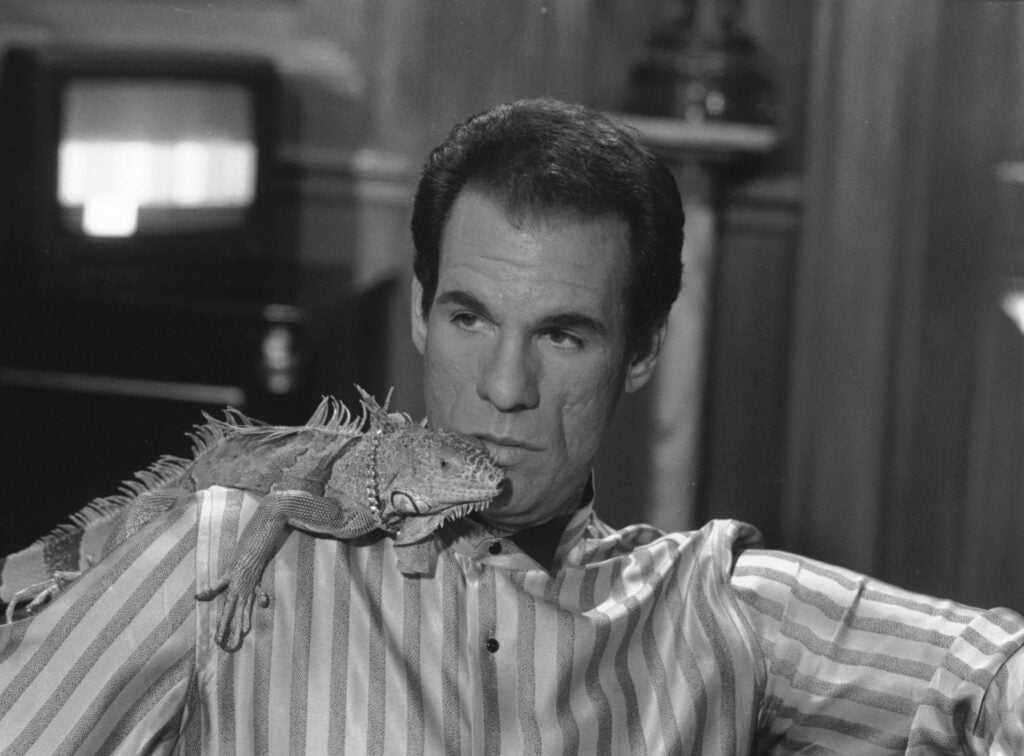
On-screen: If Blofeld’s pet of choice is a cat, Licence To Kill’s chief villain, Franz Sanchez (Robert Davi), is often seen with an iguana on his shoulder. In one moment, the reptile is seen wearing a jewel-encrusted collar, a gaudy signifier of Sanchez’s criminality and decadence.

Off-screen: The character has another animal association: Sanchez uses a stingray tail to whip his mistress, Lupe Lamora (Talisa Soto). The idea was taken from Ian Fleming’s short story The Hildebrand Rarity, where it is used by Milton Krest.

Q’s Cat

As seen in: No Time To Die (2021)

On-screen: Q (Ben Whishaw) is preparing for an intimate dinner when Bond (Daniel Craig) and Moneypenny (Naomie Harris) interrupt his plans and enlist him to analyse files relating to Project Heracles. Looking around Q’s stylish apartment, Bond notices Q’s hairless Egyptian Sphinx cat and quips, “You know, they make them with hair these days?”

Off-screen: The cats were included as a callback to Q, referencing that he owned cats in Spectre. The cats were placed on set weeks before filming started to allow them to acclimatise and, come the filming, were very well behaved.

Bond By The Sea

An iconic shot in Bond’s history. Ursula Andress walking out of the sea in Dr. No has reverberated around the series in different ways, being explicitly referenced in Die Another Day and gender-swapped in Casino Royale. Here’s how the 007 films created and paid tribute to a moment of movie magic. 

Dr. No (1962)

The Moment: Ferried by Felix Leiter’s accomplice Quarrel (John Kitzmiller), Bond (Sean Connery) arrives on Crab Key to investigate Dr. No (Joseph Wiseman). The following morning, Bond hears a female voice singing (“Underneath the mango tree, me honey and me…”). His interest piqued, he sees Honey Ryder (Ursula Andress), a beautiful woman with wet hair, wearing a white bikini and a white webbing army belt, carrying a bunch of seashells and dumping them on the beach. 

The Making Of: Producer Cubby Broccoli cast the then 25-year-old Swiss actor Ursula Andress solely from a photo of the actress in a wet t-shirt just two weeks before production. When Andress arrived on set, her costume had not been decided on, so Broccoli called United Artists executive David Picker in New York and asked him to buy three bikinis from Saks Fifth Avenue and send them to Jamaica. 

The shot was captured on February 6 1962, at the privately owned Laughing Waters Beach in Ocho Rios, St Ann, Jamaica, near Fleming’s home, GoldenEye. The shot was witnessed by the author — his first visit to a 007 set — and his wife Ann, who were out for a stroll with poet Stephen Spender and journalist Peter Cornell — the group were forced to dive to the ground to avoid being seen on camera. The song Honey and Bond sing, ‘Underneath The Mango Tree’, was written by the film’s composer, Monty Norman, and sparked a war between the two co-stars. “Sean and I fought a bit trying to get the record player, trying to learn how to sing the song,” Andress recalled. “He used to steal it away from me and I would steal it back. He sings much better than I do. I can’t carry a tune.” In the end, Andress’s singing voice was replaced by German actor Nikki van der Zyl. 

The moment has earned a unique place in pop culture, and in 2001, Andress’s white bikini sold for £41,000 at auction.

Die Another Day (2002)

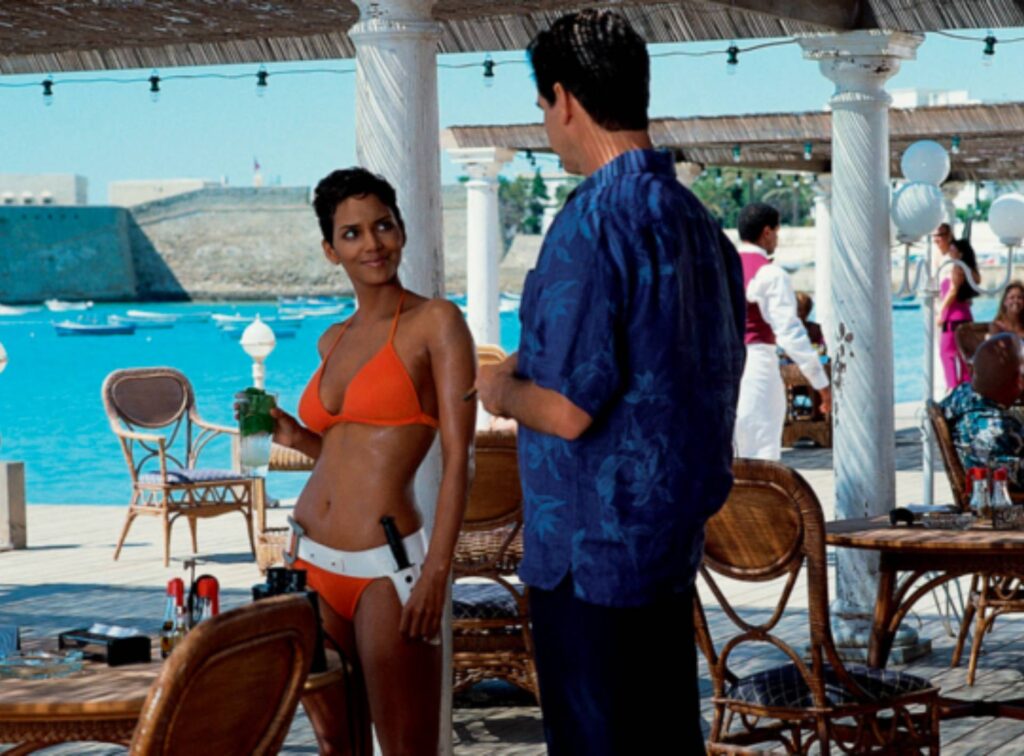
The Moment: Bond is on assignment in Cuba on the trail of Korean terrorist Zao (Rick Yune), believing him to be staying at a clinic that is changing his facial appearance via DNA-modifying technology. From a seaside resort, Bond surveys the island that plays host to the clinic by posing as an ornithologist with binoculars. His vision is interrupted by Jinx (Halle Berry) — whom we will later learn is a CIA operative — emerging (in slow motion) from the sea and walking up to the beachfront bar “Magnificent view” ventures Bond. “Isn’t it?” replies Jinx. “Too bad it’s lost on everyone else.” Sharing a mojito, it’s the start of a beautiful, if intense, friendship.

The Making Of: On April 3rd, the Die Another Day production team travelled to Cadiz in Spain, which was doubling for Cuba. Expecting sunny climes, the team arrived to rain, wind, and cloud cover with no foreseeable break in the weather. “I was hamming it up with the hot water bottles,” recalled Pierce Brosnan. “It’s pretty pathetic really — sitting there with a big fluffy blue dressing gown and a pink hot water bottle. It’s not very Bond.” 

The inclement elements also delayed the shooting of Jinx jumping out of the water, in a clear nod to Dr. No’s Honey Ryder entrance, which went further than just the action. “We wanted to pay homage to the Ursula Andress bikini,” said costume designer Lindy Hemming, “and we came up with this electric orange, very revealing and sexy bikini, and a very beautifully crafted diving belt made by a company called Whitaker Malem, which fits exactly on the top of her hips at the point where her bikini ends.” In February 2026, Berry revealed that she had kept the two-piece swimsuit for over two decades.

Casino Royale (2006)

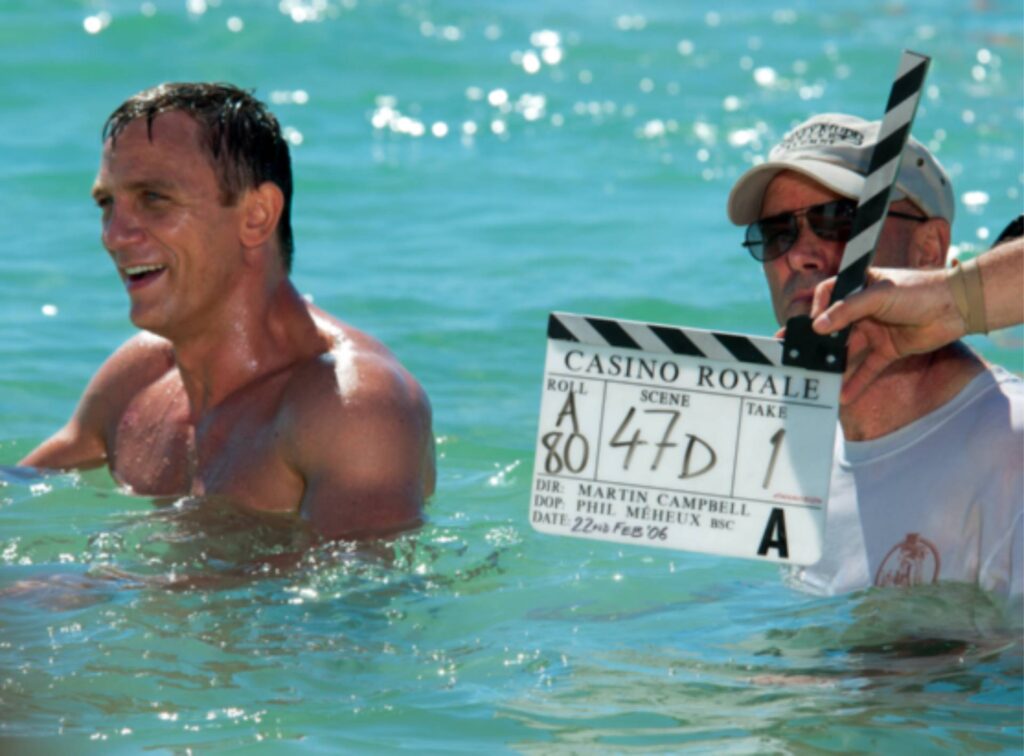
The Moment: A beach in the Bahamas. Bond, taking a break from his hunt for bomber Mollaka (Sébastien Foucan), rises out of the twinkly-blue Caribbean sea and, sporting powder-blue, tight-fitting swimming trunks, strides confidently out of the surf and toward the shore. He catches the eye of a beautiful woman dismounting from a horse — we will come to know her as Solange (Caterina Murino), the wife of criminal operative Alex Dimitrios (Simon Abkarian) — and the pair share a moment. It won’t be the last.

The Making Of: It looks a clear-cut homage to the Ursula Andress/Dr No. moment but both screenwriters Neal Purvis and Robert Wade and director Martin Campbell claim that paying tribute was not on their mind. “No matter what anybody says, I needed a wide shot,” Campbell told Mark Salisbury. “That’s it. There was no ‘Let’s do a Dr. No shot.’ It was only once the film was shown that that got picked up on but it was entirely accidental in the sense we needed a wider shot of Daniel standing up, coming out of the sea.”

Still, costume designer Lindy Hemming had Andress in mind when thinking about the scene and knew it would be memorable. She went through numerous pairs of trunks with Craig, a selection of looser board shorts alongside a tighter pair of blue trunks — Craig, who’d spent months working out, immediately went for the blue made in Italy by La Perla and labelled GrigioPerla. The trunks later sold for £44,450 at an auction of Bond memorabilia at Christie’s to mark the 50th anniversary of the series in 2012. Dame Judi Dench presided over the bidding and quipped, “All I’m going to tell you is they’re unwashed.”

Co-producer Barbara Broccoli saw immediately the impact of the look on set. “Of course, when we were shooting it and he walked out of the sea, all the women were out of their minds. The men were too. Like Ursula Andress, that image was something men and women could appreciate. Daniel exemplified the kind of man every man would like to be. Strong, powerful and beautiful.”

The moment had PR benefits too. Shooting the moment, a paparazzi photographer snapped Craig coming out of the sea. The image was sold to British tabloid The Sun, and subsequently the image circulated around the world. While the Casino Royale team was initially angered, it served to heighten awareness about the film and transformed opinion on initial, unfair reservations about Craig as Bond.

“In a way, it was the turning point,” said executive producer Anthony Waye. “Daniel Craig had been too blonde and blue-eyed for the media but suddenly he was the perfect Bond.”

Diamonds Are Forever: 55th Anniversary Edition 2-CD Release

Introducing the remastered and expanded 2-CD re-issue of composer John Barry’s original motion picture score to Diamonds Are Forever. Part of a limited edition of just 5,000, this edition showcases the film’s music with improved sound and never-before-released material. Included within this 2-CD set is the iconic title song “Diamonds Are Forever” by Barry and lyricist Don Black performed by Shirley Bassey in English and Italian. 

Diamonds Are Forever is the seventh James Bond film, released in 1971, and produced by Albert R. Broccoli and Harry Saltzman. The film stars Sean Connery, after a one picture absence, as 007, and is directed by Guy Hamilton, returning for his second film in the series.

Available to pre-order on 007Store.com, shipping mid-late April 2026.

Inside Quantum Of Solace’s Unforgettable Fire

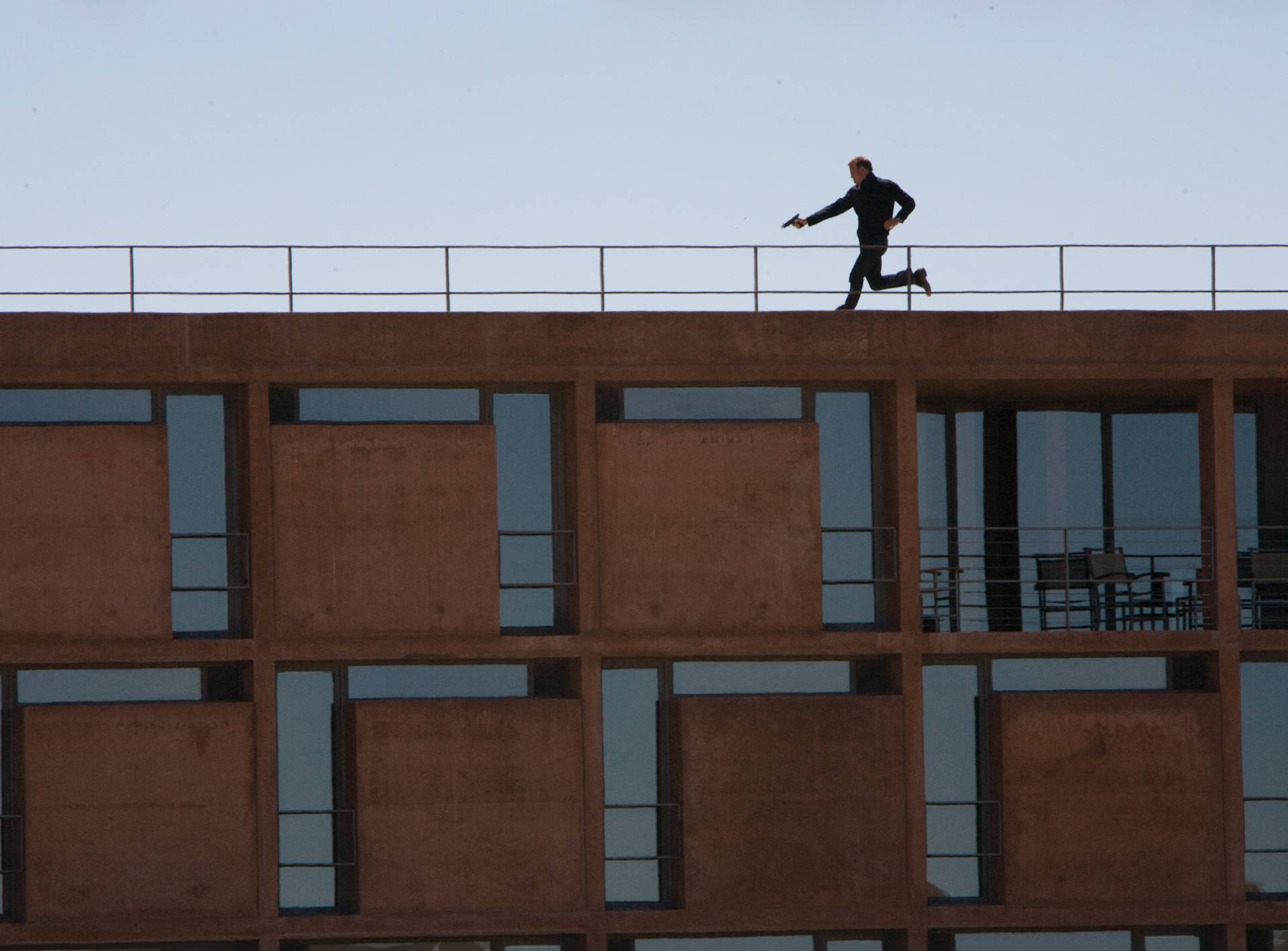
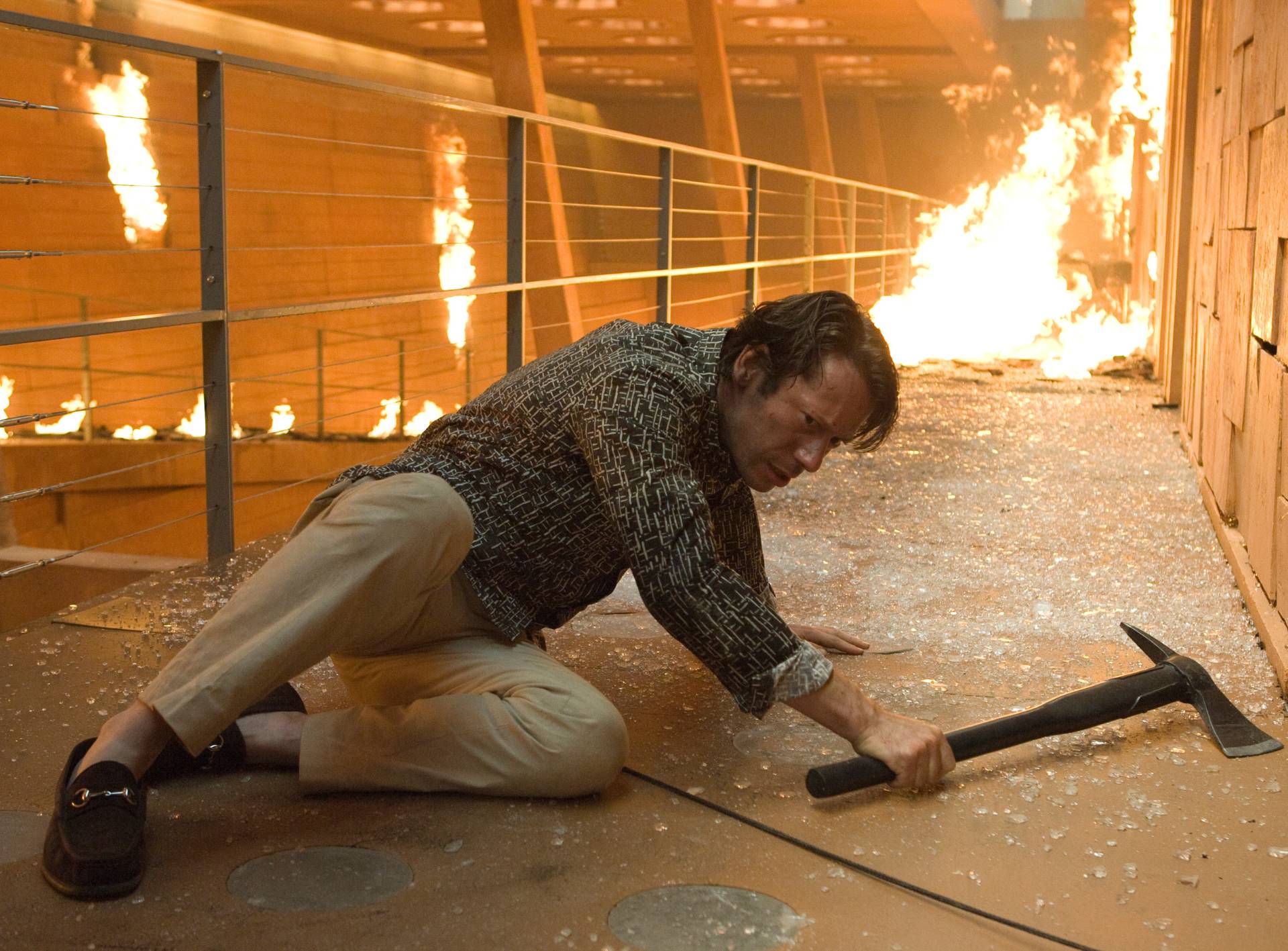
Quantum Of Solace ends in a fiery showdown at an eco-hotel in the Bolivian desert, where eco-industrialist Dominic Greene (Mathieu Amalric) and the former Bolivian dictator General Medrano (Joaquin Cosio) are meeting to discuss the overthrow of the current Bolivian government. 007 has long dealt in flame-filled sequences — the destruction of the Liparus super tanker in The Spy Who Loved Me, the fireball in the bunker in The World Is Not Enough — but the inferno at the climax of Quantum upped the ante on complicated, extensive, and explosive set-pieces.

Doubling for the hotel is the spectacular European Southern Observatory and hotel complex in northern Chile’s Atacama Desert, roughly three hours from the nearest town and situated at an altitude of 6000 feet. The location was the idea of set decorator Anna Pinnock, who had visited the Observatory and suggested it to Dennis Gassner. The production designer Google-searched the location and, by the third image, was bowled over, so immediately sent the images to director Marc Forster.

“When Dennis showed me that location, I was in awe,” Forster told Mark Salisbury. “I had never really seen anything like it. It’s such a fascinating building, and even now, looking back to it, you felt like you’re on a different planet.”

Gassner took the idea to executive producer Callum McDougall, who approached the German management company behind the complex. The owners stipulated that the production could shoot in the daylight but couldn’t use lights after dark, as it would interfere with the observatory’s monitoring of the night sky. “I said, ‘The bigger thing is, in the script, we blow this place up,’ and they went, ‘Ah,’” said McDougall. “I said, ‘It’s fine. We’ll build our own version of it’.”

Shipping a crew of 200 to the remote location, the production recreated portions of the hotel in the exterior, which was subsequently set on fire. For the interiors, the production returned to Pinewood Studios, building six interior sets, the largest filling Pinewood’s mammoth 59,000ft 007 stage from floor to ceiling with three levels of walkways and staircases. Bond shooting through the skylight was captured on March 28, then the unit shot the firestorm for four weeks in May, setting the garage and stairwell set, the lobby and restaurant, the walkways, and Medrano’s bedroom ablaze.

“We did many explosions, fire and collapsing-ceiling tests prior to filming,” said special effects supervisor Chris Corbould. “We built a full-size replica of the bedroom at Longcross Studios in Surrey to test for the dramatic end sequence where the walls are blown out to enable Bond and Camille to escape.”

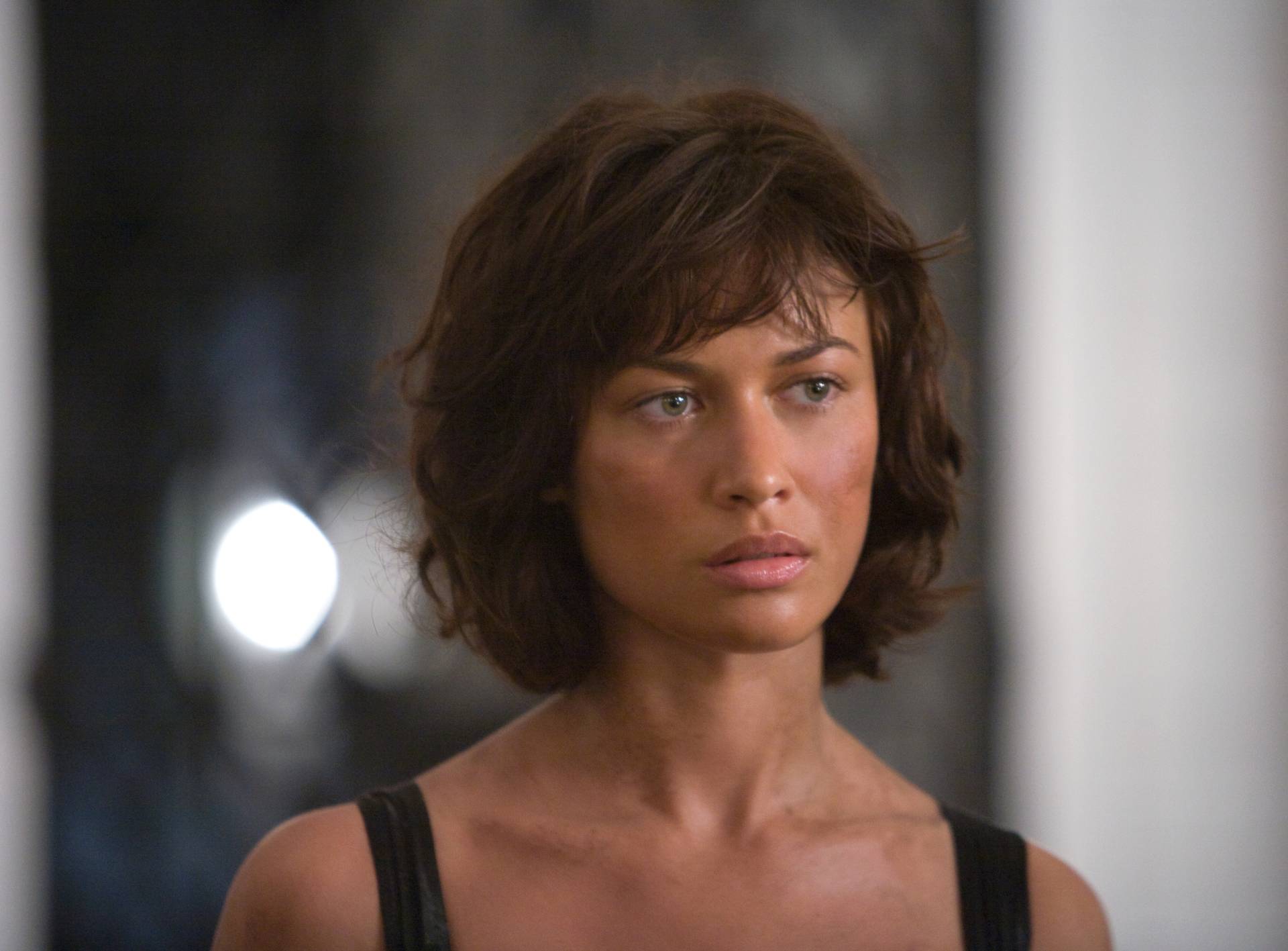
As such, the cast and crew underwent multiple rehearsals with fire, Daniel Craig and Olga Kurylenko visiting Corbould’s workshop to get a sneak preview of the pyrotechnics, helping them feel confident so they could focus on the emotion of the scene. For the showdown between Bond and Greene, stunt coordinator Gary Powell rehearsed Daniel Craig and Mathieu Amalric separately with stunt doubles and then brought them together. 

“People assume that as soon as you see fire you can’t get within 20 feet of it, but you can actually get quite close if the heat is going in the right direction,” said stunt coordinator Gary Powell. 

When it came to shooting, the actors sported Nomex fire-resistant material soaked in retardant gel under their costumes to protect them from burns.

“The hotel was eco-friendly, so we thought it would have biofuel cells for the heating. Dennis wanted to reflect that with an unusual look to the flames,” said Corbould. “We filmed the sequence using directional steel pyrotechnic pots with mixtures of petrol, isopropanol and green/blue flame fluid imported from the US. This concoction gave an orange core explosion with green and blue tinges around the outside.”

With complex choreography and huge spectacle, the filmmakers didn’t risk anything. “We had six cameras carefully placed to cover the fire and explosions, because there would be no second chances,” said cinematographer Roberto Schaefer. No second chances. Sounds like a motto Bond might live by. 

The Vehicles Of Timothy Dalton’s 007

Timothy Dalton’s 007 adventures traversed the gamut of exciting vehicles. From gadget-laden cars to high-tech ships to heavy-duty aircraft (not to mention one unforgettable cello case), Bond’s many modes of transport have added different textures and colour to the drama. Here are seven of the Dalton era’s most dynamic rides.

LAND ROVER 88 SERIES III

AS SEEN IN: The Living Daylights

THE VEHICLE: The Land Rover 88 Series III is a munitions truck, part of a series designed by the Rover group. The series I was designed as a response to the American jeep during World War 2.

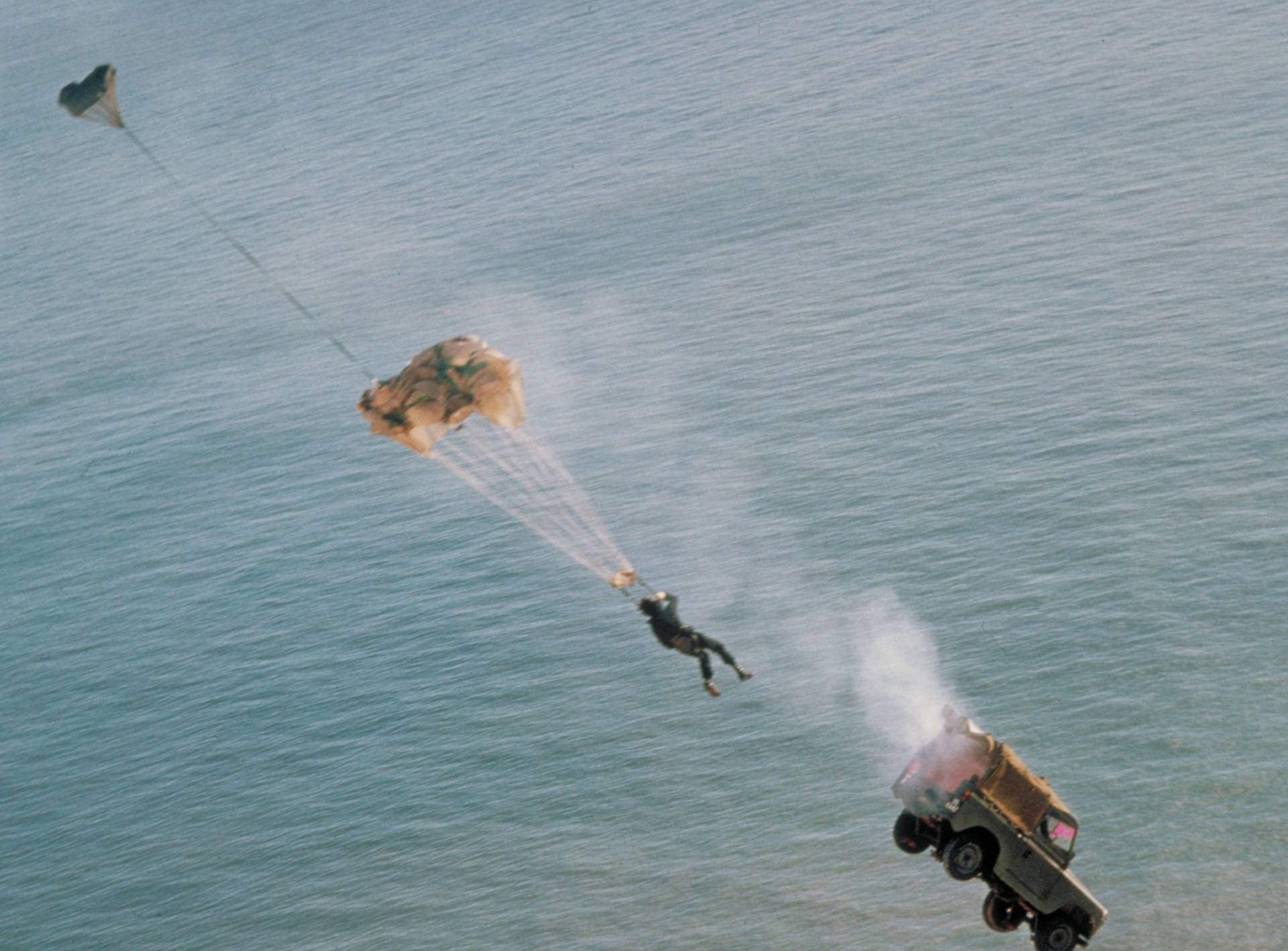
THE ACTION: Bond is participating in a training exercise penetrating radar installations in Gibraltar with fellow MI6 agents 004 and 002. During manoeuvres, 004 is killed by an assassin who steals a Land Rover and speeds off. 007 gives chase and leaps onto the roof. When the Land Rover crashes through a checkpoint, a soldier fires at the vehicle, igniting crates filled with explosives stacked in the back. With the burning vehicle careering around the cliffs, Bond cuts through the canvas roof with a combat knife and begins tussling with the driver. 

The increasingly out of control Land Rover crashes through newsstands, alfresco restaurants, and a Volkswagen Beetle before flying off the cliff edge towards the sea. Bond escapes by engaging his parachute and flying out of the rear compartment as the jeep spectacularly blows up in a mid-air explosion. 

ASTON MARTIN V8 VANTAGE VOLANTE

AS SEEN IN: The Living Daylights

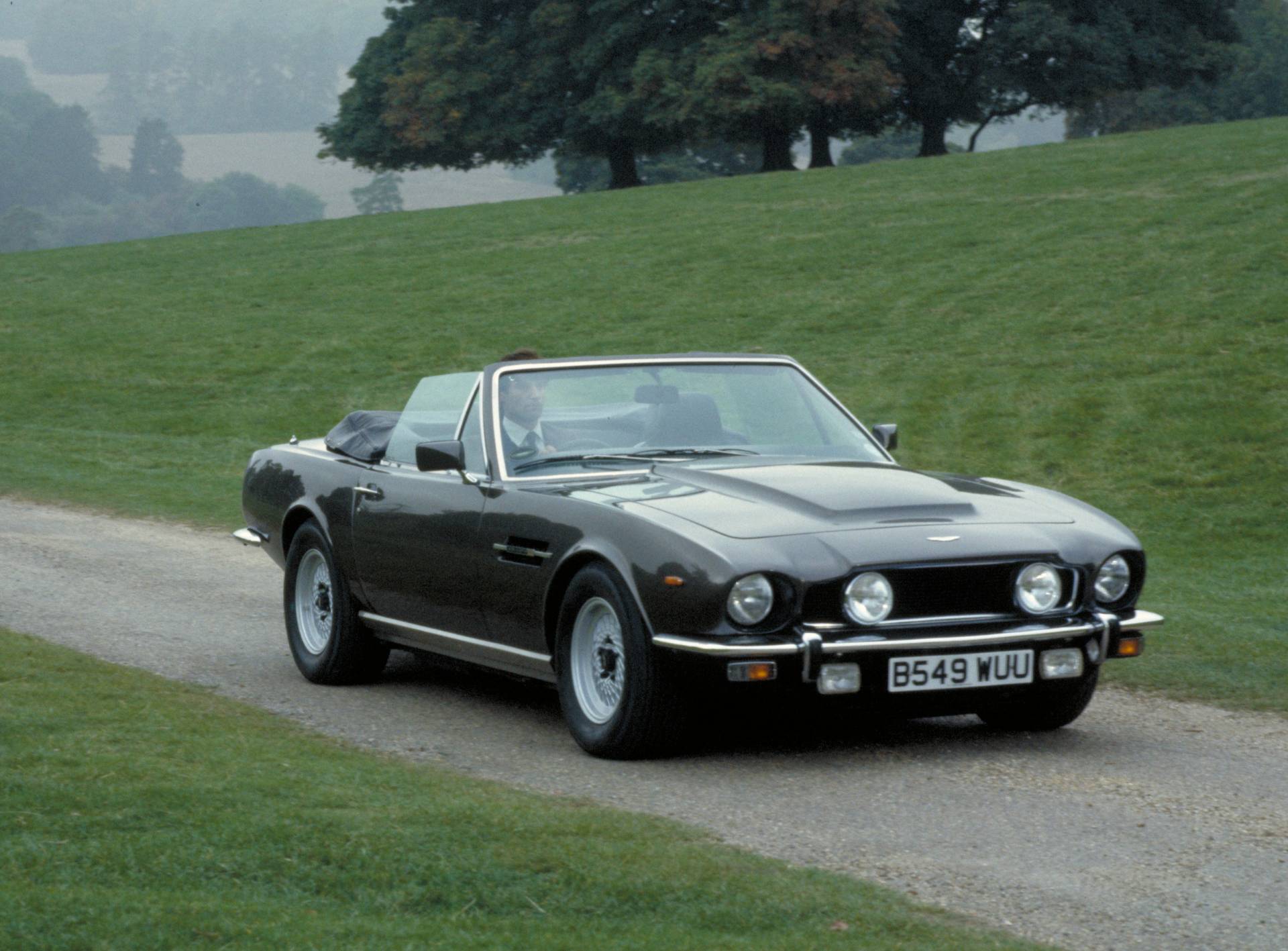
THE VEHICLE: Aston Martin returned for the series for the first time since On Her Majesty’s Secret Service with the V8 Vantage, the production sourced three Vantages for use in the filming. 

THE ACTION: Pursued by the KGB and Slovak police, Bond (Timothy Dalton) and cellist Kara Milovy (Maryam d’Abo) speed to the border between Bratislava and Austria. During the chase, Bond unleashes a plethora of Q Dept’s hidden gadgets; a laser beam installed in the hubcap (which removes a police car from its axel), retractable skis and spiked tyres to help movement across the ice; bulletproof windows, front mounted rockets (hidden behind the fog lights) and a rocket booster to give the car an extra lift. The car also has a self-destruct mechanism that Bond activates when the Slovak police approach.

CELLO CASE

AS SEEN IN: The Living Daylights

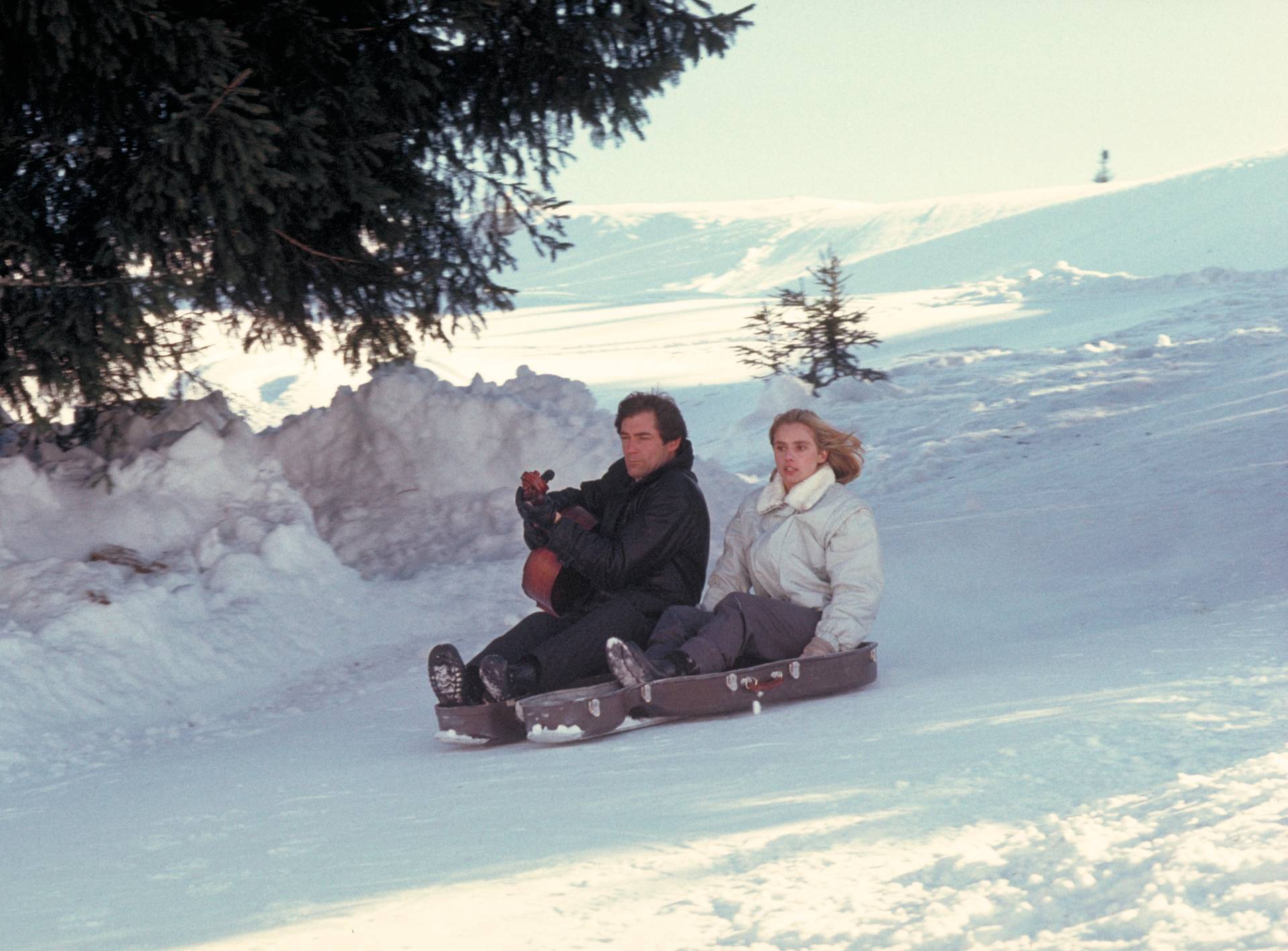
THE VEHICLE: The girlfriend of the villainous Koskov (Jeroen Krabbe), Kara Milovy, is a world-class cellist. Her bulky cello and its case might initially have been a hindrance — “Why didn’t you learn the violin?” quips Bond — but it proved to be a lifesaver.

THE ACTION: Heading for the Austrian border, Bond’s Aston Martin loses its skis and comes to a sudden stop in the snow. Exiting the car, Bond and Kara come under heavy fire, so 007 takes the cello case and improvises into a toboggan, using the cello as a rudder. Reaching the Austrian border, Bond tosses the cello over the barriers, quipping, “Nothing to declare!” It’s no way to treat a Stradivarius.

LOCKHEED C-130 HERCULES

AS SEEN IN: The Living Daylights

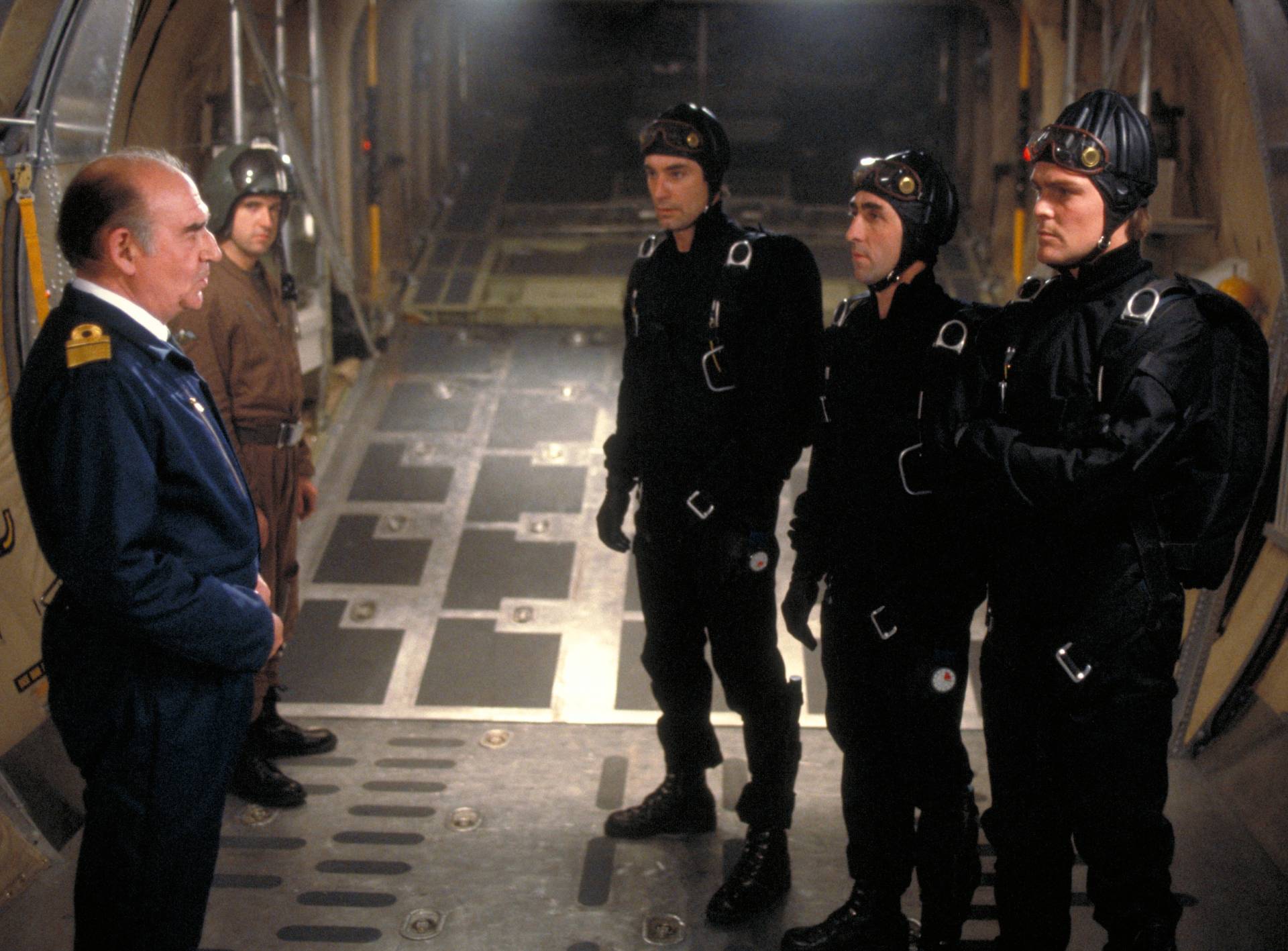
THE VEHICLE: A four-engine cargo aircraft, the Hercules appeared in You Only Live Twice before its starring role in The Living Daylights. The aircraft appears twice, firstly as the RAF plane used to drop the 00 agents into Gibraltar but takes a more substantial role during the siege at the Soviet airbase in Afghanistan.

THE ACTION: Helped by the Mujahideen, Bond and Kara infiltrate an air base to plant a bomb in a Hercules carrying a large shipment of opium waiting to be sold by Koskov and Whitaker (Joe Don Baker). Bond hijacks the plane, and Kara assumes control as he defuses the bomb. Meanwhile, mercenary-for-hire Necros (Andreas Wisniewski) has stowed away onboard and charges at Bond. The threat is heightened when Kara accidentally opens the cargo doors. The two men are sucked out of the plane, hanging onto the net holding the opium for dear life — as Necros hangs from 007’s boots, Bond cuts the laces, and the assailant plunges to his death.

But the danger isn’t over, even after Bond manages to utilise the bomb to drop it on Soviet soldiers fighting the Mujahideen. Machine gunfire from the ground battle punctures the fuel tank, and the Hercules plummets to the ground. Bond quickly improvises an escape. Pulling the release chute on a jeep in the hold, Bond and Kara exit the aircraft as it crashes into Pakistan airspace. When the dust and the vehicle settle, 007 suggests he knows a good restaurant in Karachi, and the pair head off for dinner. 

THE WAVEKREST

AS SEEN IN: Licence To Kill

THE VEHICLE: First appearing in the Ian Fleming short story The Hildebrandt Rarity as a luxurious cruiser, the Wavekrest in Licence To Kill is a drug emporium masquerading as a marine research vessel.

THE ACTION: The Wavekrest is owned by the businessman and drug smuggler Milton Krest (Anthony Zerbe). The ship contains a luxurious state room and pieces of oceanographic research equipment used to mask its purpose of smuggling cocaine. The vessel also plays host to an unmanned, remotely-controlled underwater vehicle that is deployed to transfer narcotics and money in concealed compartments. 

On the trail of drug kingpin, Franz Sanchez (Robert Davi), Bond infiltrates the ship and scuppers the drug lord’s latest shipment, stealing five million dollars. Later, Bond reboards the Wavekrest and sets up Krest by placing the missing millions into the ship’s hyperbaric chamber. When Sanchez discovers the money, he entraps Krest in the chamber and, with an axe, rapidly depressurises the chamber, dispatching Krest to a grisly demise.

THE KENWORTH W-900

AS SEEN IN: Licence To Kill

THE VEHICLES: A fleet of trailer trucks used by Franz Sanchez to hide and transport illegal drugs. Sanchez uses a clandestine drug lab to dissolve 20 tonnes of cocaine into petrol shipments — the drug lord provides a process to separate the drugs from the petrol and solidify them for resale.

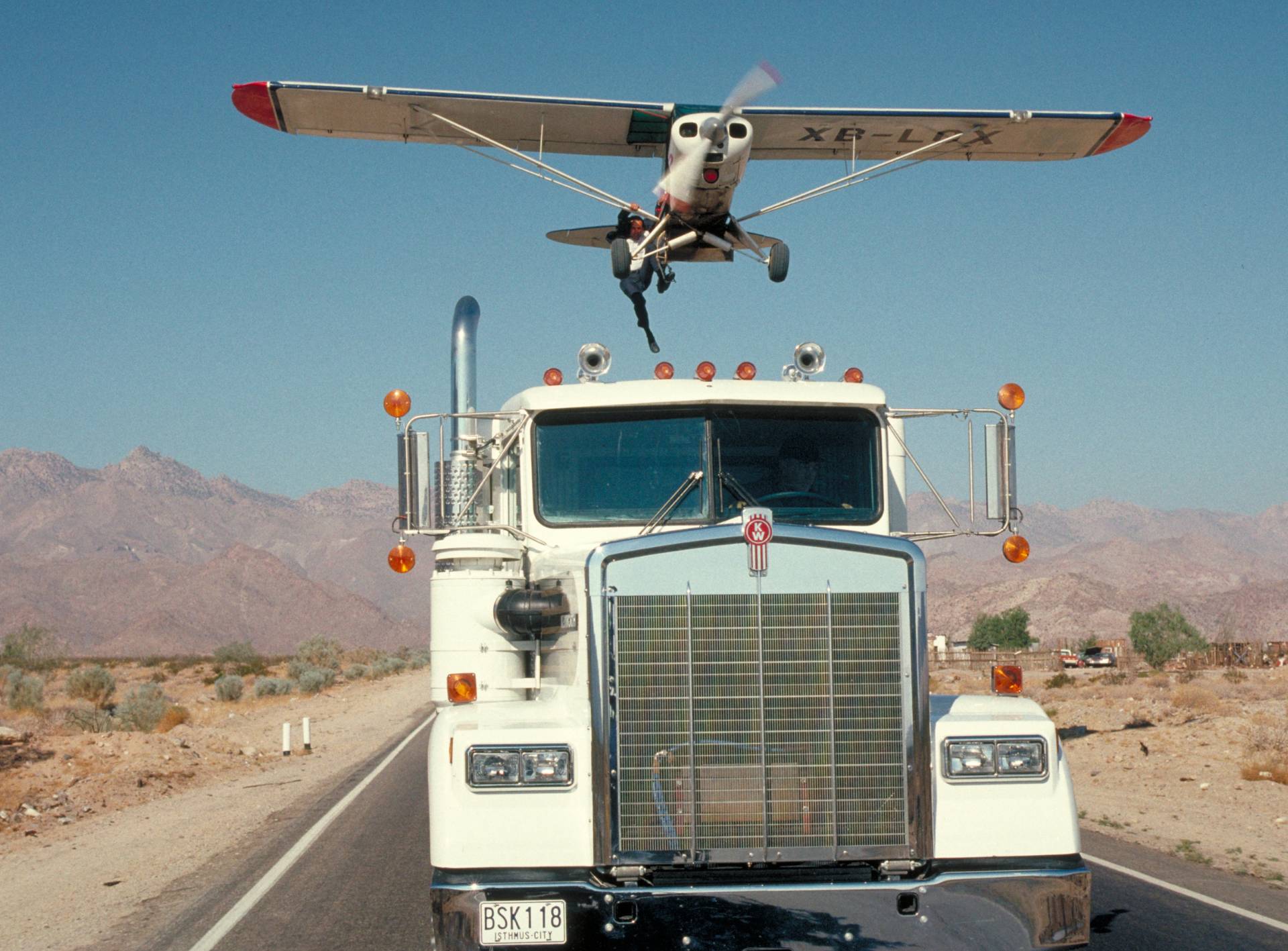
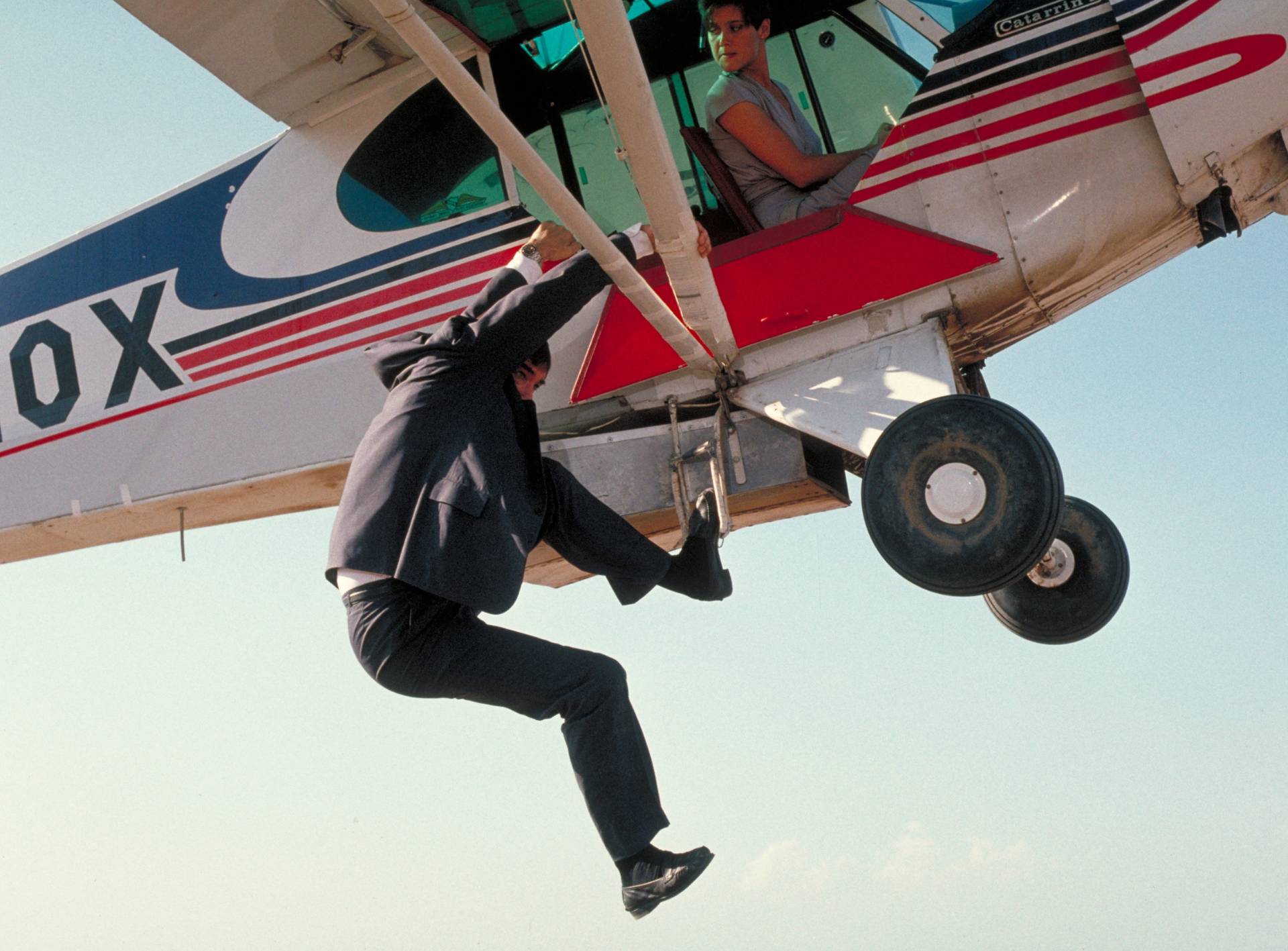
THE ACTION: After Bond destroys the lab converting the cocaine to petrol, Sanchez orders four trucks to transport the narcotics, joining the procession in a Maserati. In a Piper Super Club, flown by CIA agent Pam Bouvier (Cary Lowell), Bond tracks the trucks, leaping from the plane onto the top of a Kenworth trailer. Ejecting the driver from the cabin, Bond sets out to disrupt the convoy. Evading a Stinger Missile by jacking the vehicle on its side, Bond then takes out the next Kenworth by decoupling the tanker and rolling it down the hill so it collides into the third tanker, causing a huge explosion.

Driving through the resulting fire by lifting the engine in the air, Bond is on the tail of Sanchez, who has commandeered the remaining truck. Bond scrambles onto Sanchez’s tanker, opening the valve to let the diluted drug stash pour out onto the road, creating a trail of fire. As 007 climbs towards the truck’s cabin, Sanchez’s henchman slams on the brakes, forcing Bond to fall forward. The truck moves off again, with Sanchez chasing Bond with a machete. The pair fight as the Kenworth, with its driver having bailed, topples over down a steep bank, leaving Bond and Sanchez dazed but ready for a final duel. 

PIPER SUPER CUB

AS SEEN IN: Licence To Kill

THE VEHICLE:  A two-seat single-engine monoplane flown by CIA agent Pam Bouvier that plays a pivotal role in helping Bond stop Sanchez’s convoy. 

THE ACTION: During the hunt for Sanchez, Bond and Bouvier arrive in Isthmus in a Beechcraft B55 Baron aircraft, which is later dismantled by Sanchez’s men to stop the CIA agent following Bond to Sanchez’s cartel operation. Bouvier steals the Piper Super Cub to continue the chase, and after Bond destroys the lab, gives him a ride to pursue the tanker convoy. 

During the pursuit, she saves Bond’s life by dropping dust on Sanchez’s men as they move in for the kill. Later in the chase, Sanchez blows a hole in the Piper’s tail, forcing the plane to crash into the rocks, breaking off the wings. Showing her facility with a very different kind of vehicle, Pam shows up in the last remaining Kenworth tanker truck to pick up an exhausted Bond after he has defeated Sanchez.

How Daniel Craig Became James Bond

In 2005, James Bond producers Michael G. Wilson and Barbara Broccoli decided the series needed a reboot. Following Die Another Day, it was, in Wilson’s words, “very important to bring it back to Earth.” The decision was solidified when the rights to Casino Royale, Ian Fleming’s first James Bond book, became available, and the filmmakers grabbed the opportunity to return 007 to his realistic roots.

“It’s really the first mission that Bond has,” said Wilson. “It’s right after he got his 00 status and is about what he goes through, the physical ordeal, the mental pressures he has and then the love affair he has.”

A fresh start needed a new Bond. Casting Director Debbie McWilliams, who had participated in casting both Timothy Dalton and Pierce Brosnan, was tasked with finding the new 007 and initially focused her search on young actors to match the story of a new agent earning his stripes. Yet when it was decided to widen the age range of the actors, Barbara Broccoli had one name at the top of her list: Daniel Craig. It was an iconic role that had never been on the Cheshire-born actor’s wish list.

“When I became an actor, I never fantasised about playing James Bond,” said Craig. “As a kid, yeah, but that was being James Bond, that was something else, that was fantasy.”

A graduate of the National Youth Theatre and Guildhall School of Music and Drama, Craig had caught the eye in the BBC drama Our Friends In The North. He subsequently proved his range in a succession of diverse, critically acclaimed roles, all collaborations with major filmmakers; as the muse of artist Francis Bacon in John Maybury’s Love Is The Devil, as Paul Newman’s son in Sam Mendes’ Road To Perdition, and as a Mossad agent on the trail of Palestinian terrorists in Steven Spielberg’s Munich. While it is often cited that Craig’s lead performance in Matthew Vaughn’s Layer Cake was his calling card for 007, it was his performance as Jesuit priest John Ballard in Shekhar Kapur’s 1998 period drama Elizabeth that grabbed Broccoli’s attention.

“He defines his generation of actors,” she said. “He’s got everything that is required — he has that toughness but he has that vulnerability, he’s incredibly sexy, he’s very charismatic, and he’s very, very versatile and agile as an actor.”

While Craig had been in discussions with Broccoli and director Martin Campbell, even reading Paul Haggis’ Casino Royale script, the actor still had to do a screen test. The testing process for Casino Royale started in July 2005 under the code-name Destiny, with a second phase taking place in September using the faux title Alcatraz

Bond screen tests are elaborate affairs involving hair and make-up, costumes, sets, and other actors. Under the guidance of Martin Campbell, the would-be 007s were led through a scene from From Russia With Love, where Bond first meets Tatiana Romanova. On September 27, Henry Cavill donned the tux. The following day, Sam Worthington stepped in front of the camera, and then on September 29th, it was Craig’s turn. The actor was scheduled to do the whole day, but by lunchtime decided he had had enough. “I was like, ‘This is crazy’,” Craig told Mark Salisbury for the book Being Bond. “I started the way I meant to go on – being a pain in the arse!”

Despite Craig being perfect in the role, it was still not a done deal. The actor was wary of the huge responsibility of the role and the potential of being typecast. He sought advice from family, friends, and colleagues, including former Bond Pierce Brosnan, who just said, “Go for it.” To help allay Craig’s concerns and give him greater control over his own destiny, Broccoli gifted him creative input into the development of the script, the choice of director, and the key cast.  

Craig learned he had won the role on a phone call while out shopping, during a day off shooting The Invasion opposite Nicole Kidman in Baltimore.

“It’s a bit anticlimactic, really, because your expectations go so high, and then, suddenly, they go, ‘Yes, it’s yours’,” he remembered. “And you never really know what to do with yourself. I went out and got very drunk on my own — I was filming in Baltimore and everybody else was working. Of course, I couldn’t really tell people in the bar I was sitting in getting very drunk, ‘I’m James Bond’. I think I would have been thrown out on my ear or sent off to a mental hospital.”

The actor was announced to the world as the next 007 in a media event on the River Thames on October 14, 2005. Having flown back from the US, he was escorted to the press conference by a convoy of Royal Marine Rigid Raider Speedboats.

“I’m just glad I didn’t fall off the boat.” He laughed. “I mean, that’s really the only thing that really matters. If I had fallen off, I would have swum to the other shore and said, ‘Thanks. Goodnight. I had a go but it didn’t work.’ The Royal Marine next to me just said, ‘If you fall off, you’ll probably be dead anyway, so don’t worry about it.’”

The initial response was mixed. The actor was derided for being too short — he’s 5ft 11” — and for not having the dark hair described by Ian Fleming in the novels. He was even criticised for sporting a life preserver, which naval health and safety regulations demanded he wear at the last minute. “Apparently it was a sign I couldn’t swim or something,” he said. “I should have worn orange arm bands — it would have been a much better look.” Some of the Bond veterans had seen all this sniping before.

“When Sean Connery was hired everyone said, ‘Oh disaster!’ because he wasn’t a David Niven type,” observed Broccoli.

“It was the typical tabloid bullshit that goes with any new Bond,” chimed Martin Campbell, who directed Pierce Brosnan’s first 007 mission, GoldenEye. “You’re guilty until proven innocent.”

With characteristic good humour, the actor took all the brickbats in his stride.

“Some of the stuff that’s been said is as close to a playground taunt as you are going to get,” he laughed at the time. “‘You’ve got big ears!’ Fucking hell! Well, the only way I can do that is to get it right. Believe me, no one cares more about this than I do.”

Of course, opinions changed immediately after Casino Royale premiered on November 14, 2006. Craig became the first actor to earn a BAFTA nomination for playing Bond and took the character in new directions over four more films. Not bad for a kid who grew up playing James Bond in the playground.

And The Award Goes To…

The first Bond film, Dr. No, won ‘New Star Of The Year’ award at the Golden Globes for Ursula Andress’ portrayal of Honey Ryder.

The first 007 film to win an Academy Award was Goldfinger. Norman Wanstall won the Best Sound Effects Oscar the first time the series was nominated. “When Angie Dickinson announced I’d won I just couldn’t believe it,” recalled Wanstall. “After the presentation, you have to go outside where you’re interviewed. When I returned to my seat, I remember my wife saying to me, ‘Do you realise you’ve missed Judy Garland live?’ She always remembers that as the highlight of the whole affair, the fact that she saw Judy Garland sing live.”

Thunderball won the following year in the Best Special Visual Effects category for John Stears. The award came as a complete shock to its winner, who didn’t even attend the ceremony. “I had a call from a friend in Wisconsin who said, ‘I’ve just seen Jordan Klein receive an Oscar from Bob Hope for you in your absence. You’ve won the Special Effects Oscar for Thunderball,’” remembered Stears. “I thought he was kidding but he wasn’t. Later I had a call from the customs people at Heathrow Airport to go over and collect a package, which I did on a wet and windy day and I had to pay import duty too.”

The first 007 BAFTA went to Ted Moore for From Russia With Love. The award was for Best Cinematography — Colour.

The Bond film with the most Oscar nominations? That would be Skyfall with five, for Best Cinematography, Original Score, Original Song, Sound Mixing and Sound Editing. It won for Sound Editing (Per Hallberg, Karen Baker Landers) and Original Song (Adele, Paul Epworth).

The Bond film with the most BAFTA nominations is Casino Royale, nominated for Outstanding British Film, Adapted Screenplay, Cinematography, Editing, Original Music, Production Design, Sound, Visual Effects and Best Actor In A Leading Role for Daniel Craig, the first actor to be BAFTA nominated for playing James Bond.

Skyfall became the first 007 film to win in the BAFTA Outstanding British Film category, also winning Best Original Music for Thomas Newman.

At the Saturn Awards, created to recognise the science fiction, fantasy and horror genres, Casino Royale and Skyfall have won for Best Action Or Adventure Film. Pierce Brosnan has won for Best Actor in Tomorrow Never Dies.

Production designer Ken Adam has been nominated for four BAFTAs, for Best British Art Direction — Colour (Goldfinger, Thunderball, You Only Live Twice) and Production Design (The Spy Who Loved Me). He also was Oscar nominated for the Best Art Direction Academy Award for The Spy Who Loved Me.

Speaking of The Spy Who Loved Me, composer Marvin Hamlisch was nominated for Best Original Score at the Oscars, BAFTAs and Grammys but was pipped at the post by John Williams for Star Wars at the Oscars and Grammys, and by John Addison for A Bridge Too Far at the BAFTAs.

The first James Bond song to be Oscar-nominated was ‘Live And Let Die’. The category went on to become the series’ most fruitful hunting ground, gaining six nominations and three wins (‘Skyfall’, ‘The Writing’s On The Wall’ and ‘No Time To Die’). The year the song ‘For Your Eyes Only’ was nominated, Sheena Easton performed the song in an elaborate staging featuring Richard Kiel as Jaws and Harold Sakata as Oddjob.

The only James Bond actor to ever win an Academy Award (to date) for acting is Sean Connery, who won Best Supporting Actor for The Untouchables. He began his speech: “Good evening, ladies and gentlemen…friends… a few enemies.”

Another Bond actor, Roger Moore, played a significant role in Oscar history. Presenting the Best Actor award alongside Liv Ullmann in 1973, the third actor to play 007 was supposed to give the statuette to Marlon Brando for The Godfather. Refusing the award, Brando sent Sacheen Littlefeather to deliver a speech, criticising Hollywood’s representation of Native Americans on-screen.

In his autobiography, Moore recounted that the rejected award wasn’t retrieved from him, so he took it home, crowds outside the Dorothy Chandler pavilion shouting congratulations as he carried the little gold man home. The Academy later sent a representative to pick up the prize.

To mark 50 years of the franchise, the 85th Academy Awards paid special tribute to the franchise, the year after the golden anniversary in 2013 (the year Skyfall was eligible for awards). Bond actor and Oscar winner Halle Berry introduced a montage of clips, while Shirley Bassey performed ‘Goldfinger’ and Adele sang ‘Skyfall’. BAFTA also commemorated the 60th anniversary of the series.

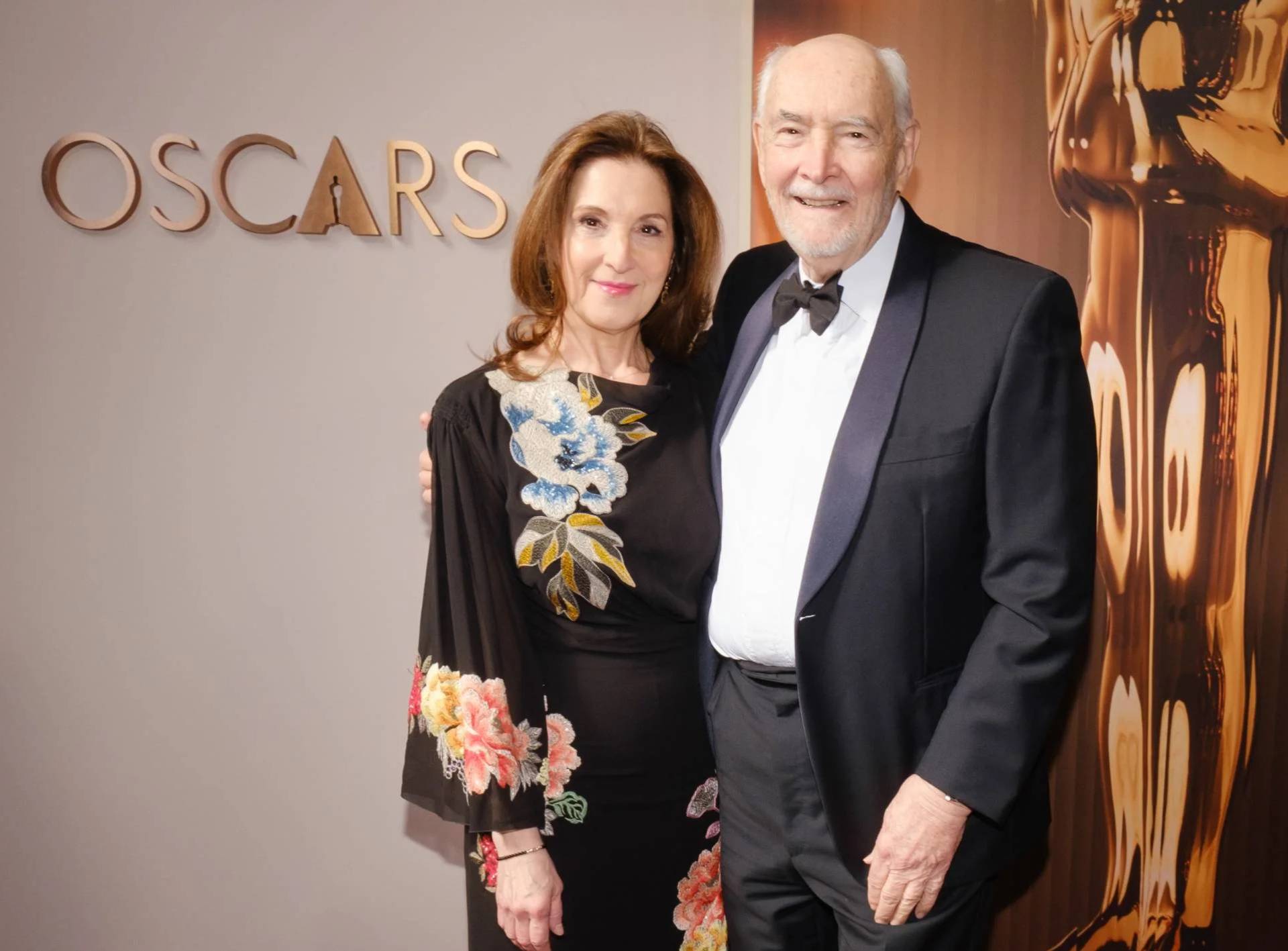
In 1982, EON co-founder and series originator Albert R. Broccoli was presented with the Irving G. Thalberg Memorial Award, which honours creativity in producing, at the 54th Academy Awards. The same honour was bestowed on Michael G. Wilson and Barbara Broccoli at the 2025 ceremony, receiving an Oscar statuette rather than the traditional bust of Thalberg. The series was also celebrated with a medley of songs sung by Lisa (‘Live And Let Die’), Doja Cat (‘Diamonds Are Forever’), and Raye (‘Skyfall’). The sequence started with actor Margaret Qualley dancing to the James Bond Theme.